Wednesday, March 9, 2016

Things I learned from start of the season racing

So far in 2016, I’ve competed in two weekends of racing: the Vancouver Sprint Camp and Desert Run.  In both events, I did some things well and some things not so well. I had good races and not as good races. Since they’re at the beginning of the season though, I can learn a lot from them, particularly about where I can improve, and therefore what I should focus on during my training in the next few months leading up to more important races. As it has been a little while since both of these events, I’ve had enough time to reflect on them.
For me, the first big races of 2016 were Sprint Camp’s series of 5.  As the name suggests, these races were all sprint-type short courses on a single weekend. The first one was at Queen Elizabeth Park:


I took this one too fast at the beginning. I was overly excited to run my first race of the year, and I wanted to have a speedy race. Unfortunately, this led me to be too imprecise in my planning. For example, going to control 2, I thought to myself something along the lines of ‘get onto the concrete part below the round building and take stairs down towards the control’. Because I wasn’t precise enough about which stairs to take, I started going down the wrong ones and ended up losing more time backtracking than I would’ve lost with another map glance and adding to the thought ‘the stairs at the end of the concrete bit’. There were also some other instances on the course where I made similar mistakes, but one thing I think I did well was my flow through the controls from 9 on wards.  This makes me think my planning improved throughout the race.

The mass start of the Elite Men at a race on Saturday (Photo: Meghan Rance)

To prepare for the next races, I reflected on the race at Queen E Park and so my goals in the next couple of races were to plan in advance more completely. I think my orienteering certainly improved because of that goal. I learned to not let the hype of the races allow room for costly mistakes and that sometimes taking a couple seconds to look at the map can save more time than it took.
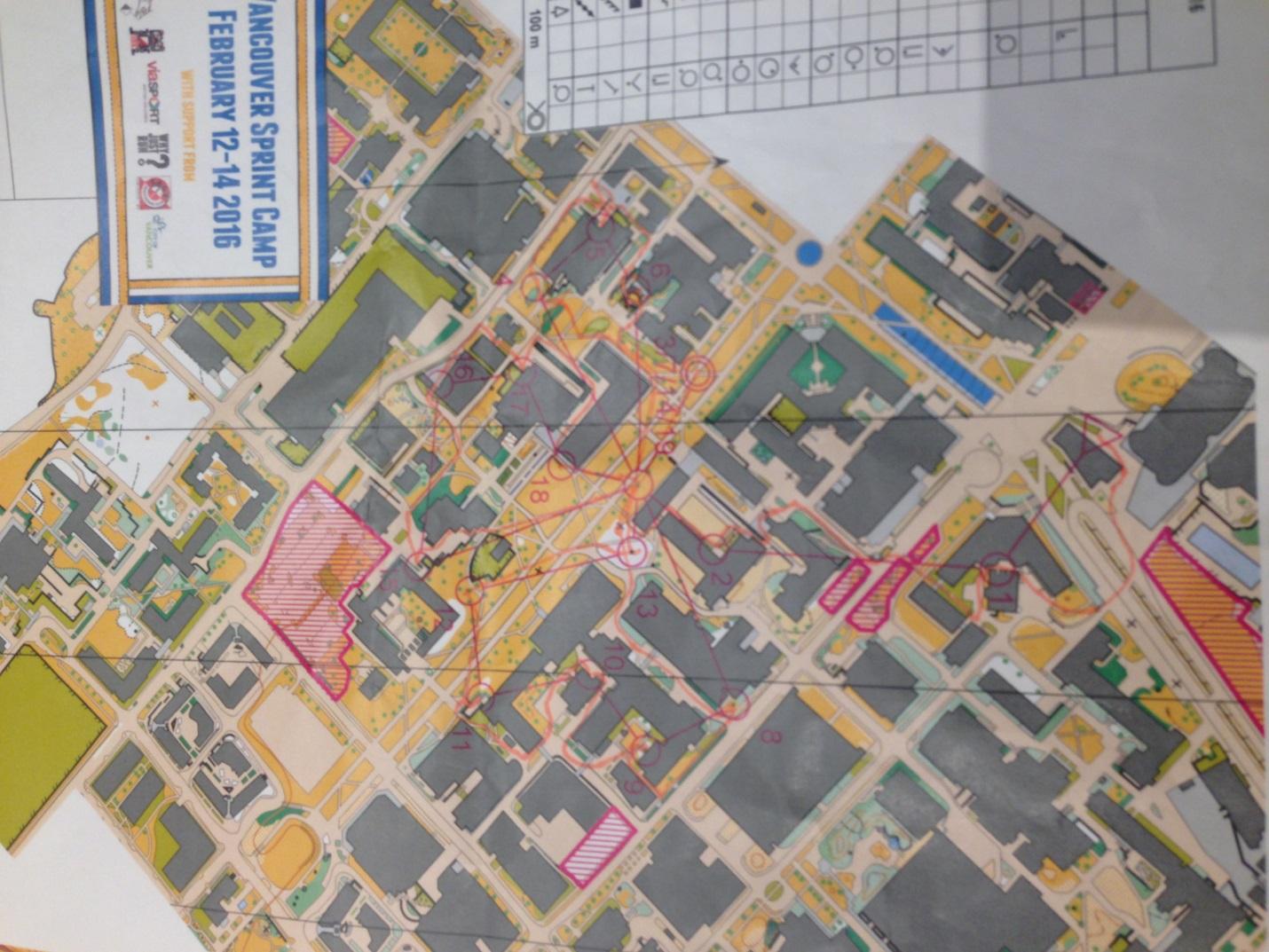
Not surprisingly, I orienteered much better the last day of racing. This included two exciting races on the UBC campus (my home turf, currently).  They were a set-up and chase format, with the chase being looped.
C:\Users\WIN7PA~1\AppData\Local\Temp\IMG_0255.JPG

(Sorry for the bad quality photo)
I started the chase a bit easier because my calves had been bothering me and focused on clean navigation. It was a mass start and the first loop went cleanly navigationally for me except for a bobble due to my misinterpretation of the map at 5 (there are stairs under the canopy). Then, after the first loop, I started accelerating, being pushed by the thought of running my best race (against the others who had started with me) but still being completely ‘in the zone’ and thinking about navigation.  I ran all out until the end and finished with probably my best results of the weekend even though I’d taken the first part a little easy. Reflecting on things I didn’t do as well in the first races of the weekend allowed me to do better in the last ones.

HPP members at the 2016 Vancouver Sprint Camp (Photo: Marsha Fehr)
(Left to right: Damian Konotopetz, Michael Svoboda, Jeff Teutch, Jan-Erik Naess, Jennifer MacKeigan, Christian Michelsen, Emma Sherwood (me), Leif Blake, Pia Blake, Adam Woods, Emma Waddington, Tori Owen, Graeme Rennie and Coach Brent Langbakk )

The second set of races that I attended a couple weeks later was Desert Run. This was a two day event in eastern Washington State where I opted for the middle distance course the first day and the long course the second day (see Pia’s blog post about it here: http://teamcanadaorienteering.blogspot.ca/2016/03/a-bit-of-blue-sky.html ). The first day I really struggled with interpreting the terrain and rushed many of my first controls which caused me to have some poor route choices at the beginning and even to have to relocate once. Once I got into the map, after about the 7th control, things went a bit smoother. I think this demonstrates the usefulness of practicing on maps with similar terrain before big competitions. I had raced on some similar terrain before; some of the maps in the middle of BC have some similar features but that was a while go.  Additionally, having not raced in a while, I should have taken the first control easier and worked on remaining calm and focused at the start of the race. I failed to do so that day. At control 6, I told myself to refocus, a skill l that I like to think I’m improving at, and things generally got better thereafter.

The second day, I planned to remain calm at the beginning and take it a bit easier and I did. The second leg of the course was a long route choice leg. As I had not had time to plan it during the short first leg, I paused to quickly look at routes and quickly picked a good one. Although I was still figuring out the map, because there were a lot more interesting cliffs and rock features then the day before, I think my pause to plan was beneficial in the long run because I navigated cleanly (even if a little less speedily then I would’ve liked) to control 2.(Course: http://www.5z.com/urban/gadget/rg2/#150&course=1 )
I was very happy with my advance planning and route choice for the rest of the race, but not necessarily running speed until nearer to the end. When I was approaching the 17th control, a bunch of fast orienteers caught up to me and my speed improved quite considerably. The seemingly head-to head racing made me run faster. Learning from this, I would like to try to always have the ‘you’re trying to beat this person now’ drive to go faster as long I'm in control navigationally. As an orienteer, although I don’t necessarily see the competition the entire race, its still there and should still push me to orienteer at the top of my ability for the entire race, not just when I see competition.
The gorgeous race terrain:
In general, even though these races were all quite different, there were some similar themes throughout that are important for me to try to work on before my next races:
1. Don’t let the stress of the races cause you to go too fast at the beginning and make mistakes.
2.    Taking a second to plan/ map read can save you from mistakes later.
3.    Remember it’s a race/ treat it like you’re always running against someone (but don’t neglect map reading because making mistakes loses more time than slowing down to map read).
4. Learn from mistakes made in the first races of the series to improve in the next ones.
Although I’ve certainly all heard these things before, these races gave me real experience with those learning outcomes so that I myself believe them to be completely true and will work hard to avoid making mistakes like these in the future.

Friday, March 4, 2016

A bit of blue sky

After a couple months in Vancouver, I was hankering for some good old forest.  This past weekend, I may have gotten off the sprint map, but not necessarily into woods.  Instead, I got the chance to run on some one-of-a-kind terrain in Eastern Washington: grasslands!

Saturday morning opened a bit chilly, but there was a gorgeous blue sky. The terrain was very open, with a couple of marshes near the finish, but the rest was grassland interspersed with little patches of trees.  This meant that there was little in terms of route choice, but a lot of looking up and sighting ahead with the trick being to look for the big features.  There were also some interesting rock features.

A bit of bright blue sky

Would you go north or south from 6-7?
I felt pretty confident with my race.  It was my first time in a while on a non-sprint map, so I took the first couple controls to get into the scale and the mapping.  I found the contours to be sometimes difficult to read,  so I ended up sighting up for cliffs and forest clumps: very helpful in keeping me in line.

Results: http://obasen.orientering.se/winsplits/online/en/default.asp?page=classes&databaseId=40740&ct=true and route choices: http://www.5z.com/urban/gadget/rg2/#149

Driving to day 2 we encountered a beautiful sunset
Day 2 was another gorgeous day, with some incredible natural walls that made for very interesting route choice.  Like day 1, the terrain was very open, but unlike day 1 it was impossible to run in a straight line.  This time, compass was of the utmost importance, as figuring out where you were after getting lost was made all the more challenging by a lack of distinct features.  

How would you go from 1-2?
This race started out ok, and going to number 2 I decided to take a route that did not involve too many cliffs and direction changes.  Fairly pleased with that leg, I made an error going to 3: I ended up coming off the cliffs in the wrong place, and as a result made a parallel error.  From there, I decided to be extra careful, and rest of the race went by with relatively smooth sailing.


A couple of the 'natural walls'

Can you guess which control on the long course this is?
A big thank you to all of the organisers - it was an amazing experience, and I am definitely looking forward to going back!  Thank you too to the Woods for making it possible for me to get there.

Wednesday, February 17, 2016

Sprint Camp 2016

Last weekend was one my favorite orienteering events, the Vancouver Sprint Camp.
The event attracted a dozen HPP athletes and 115+ participants. Thought the weather didn't entirely cooperate, the rain made the two person relay a more memorable experience.
Results (and some of the maps) can be found here.

Putting on an event of Sprint Camp's quality involves a ton of effort.On behalf of the HPP, I'd like to thank all those involved in putting on another great Sprint Camp:
Event Director- Alison Schoenhardt
The Coach and Presenter - Brent Langbakk
Organizers - Brian Ellis, Marg Ellis, Karen Lachance, Bruce Rennie, Kate Knapp
Controllers - Louise Oram, Thomas Nipen, Magnus Johansson, Meghan Rance
Course Planners - Stan Woods, John Rance, Robyn Rennie, Mike Rascher, Hilary Anderson, Ben Smith

This it is not a complete list, so to all those I've forgotten, Thank you.


Wednesday, January 6, 2016

Planning out the Spring

    Now that the winter sports are ending, and orienteering is getting closer, it has been time for me to organize my spring season. For me this means that I need to keep several things in mind:
  1. A smooth transition from winter to summer sports
  2. Make sure not to train to hard...rest days are needed!
  3. Early on I should be building my base and as JWOC approaches I can start working on speed.
  4. Plan which skills my orienteering trainings should focus on.

Screen Shot 2016-01-01 at 2.14.41 PM.png
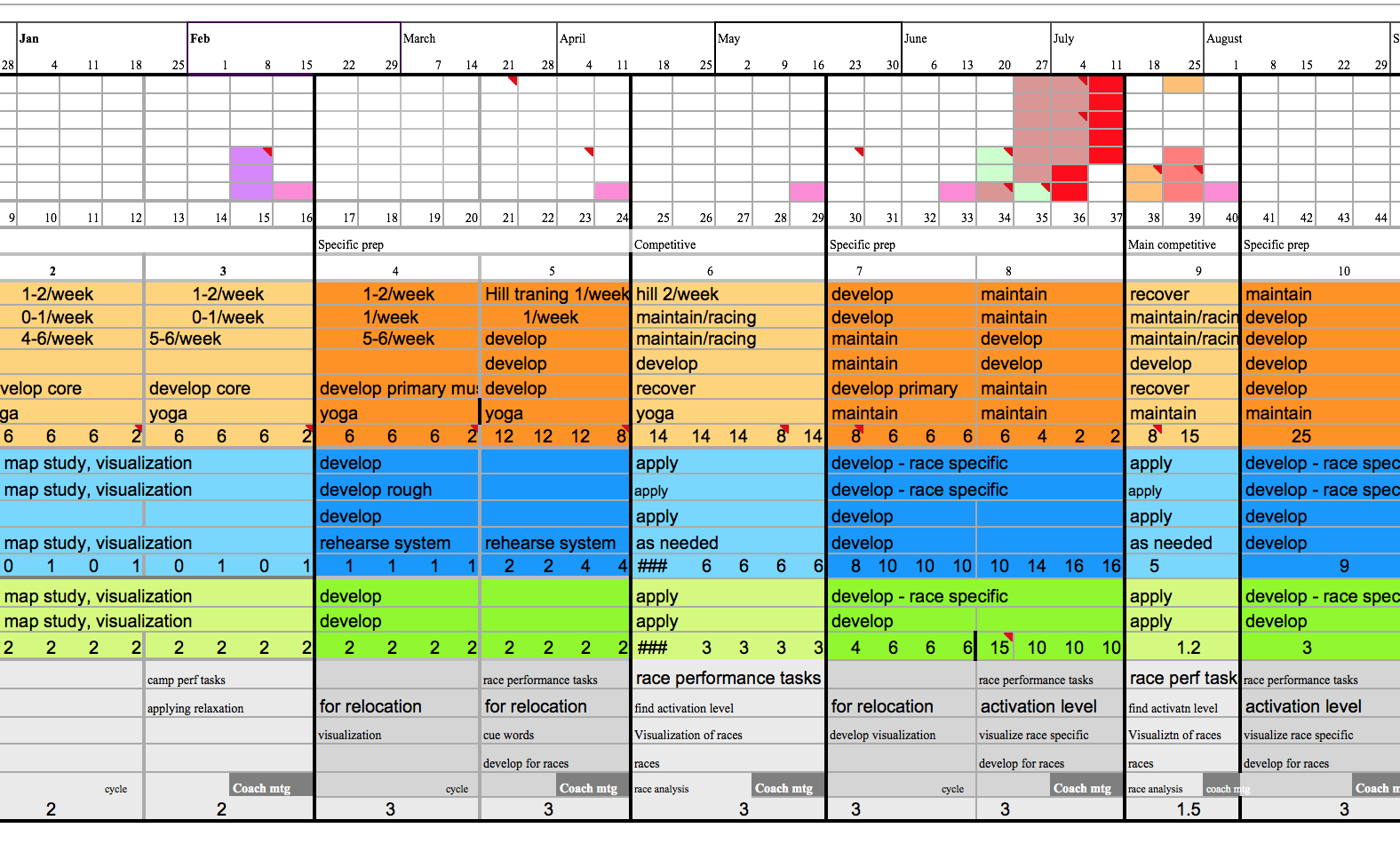
My YTP in its most basic form. This is what my training periods are planned from.
    The first part to planning out my spring program is going back to the Yearly Training Plan that we put together in our application for the High Performance Program. I use this to help me simplify weeks into categories like: peek, develop, and recover. After getting a broad understanding from the YTP I move over to my Google Sheets “Training Plan,” where I make my day-to-day schedule.
    Before putting any workouts down I look into my options for races, and training camps. It is important to find those larger events so that you can plan your training program around being ready for each and every one of them.
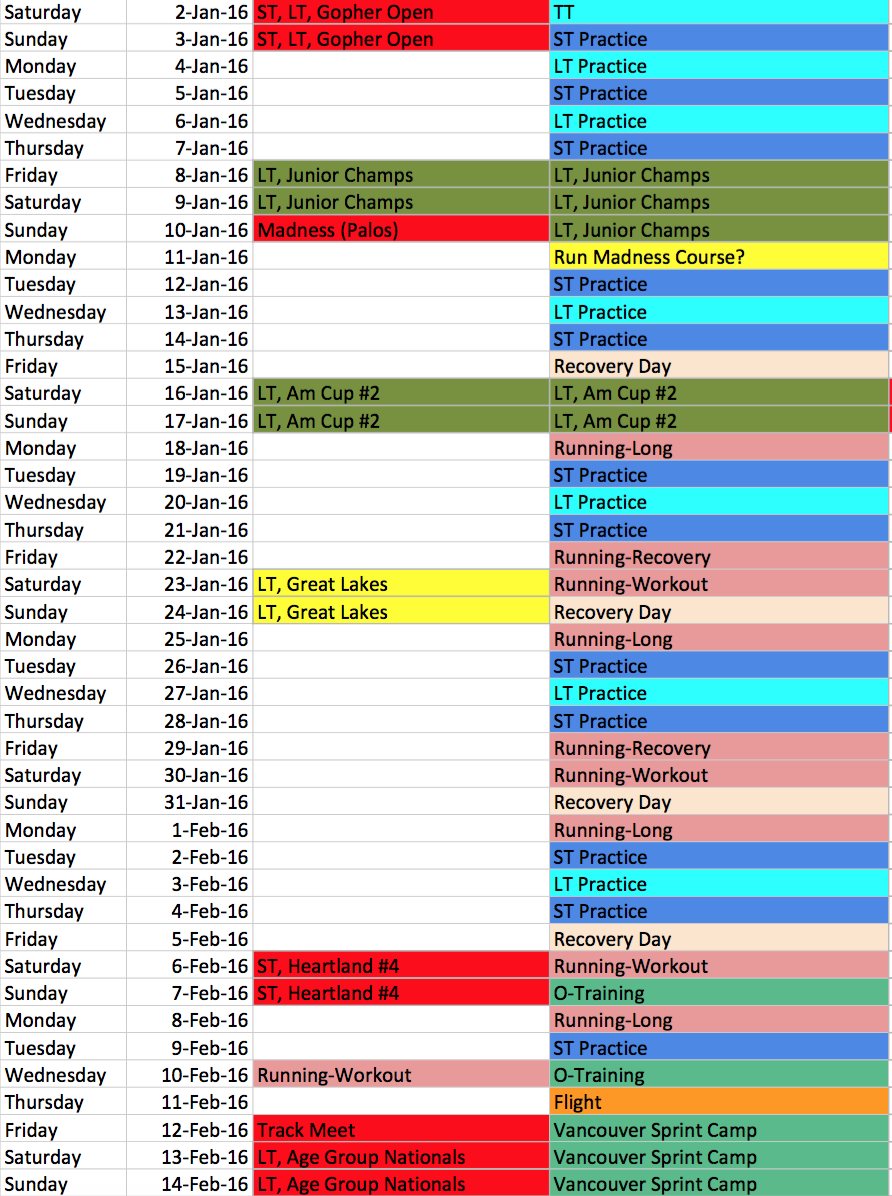
    To figure out which races and camps I will be going to I first write them all down and highlight them in yellow. This means that there is a possibility I will go to them. After that I add my other workout schedules. Because I run with my school’s track team, I know which days we will be doing workouts, long runs, and recoveries. After adding all of those days in, as well as track meets, I am able to start trimming them down to fit my program.

Screen Shot 2016-01-01 at 2.38.18 PM.png
My planned transition from speed skating to orienteering in time for the Vancouver Sprint Camp
    First and foremost, I need to work on my transition between speed skating and running, which is similar to most orienteers when they transition from skiing to running. For this I pick out my major races in speed skating, Junior Nationals, and a deadline in orienteering, the Vancouver Sprint Camp. Knowing those two dates I organize a peak in speed skating for the week before Junior Nationals which will be used to tapper. After that I work on slowly incorporating running into my weekly schedule so that I am fit for the Vancouver Sprint Camp, thus making the most of it.
    The second part that I need to decide on was which day of the week to use for my rest days. This was important because in the past I have been too aggressive and not rested enough, causing injuries which become major setbacks. From looking at my YTP I decide that for early Spring I will use Saturday as a rest day because that will cancel out a hard workout, and add a long run, thus allowing me to work on building my base. Further down the road I switch my rest day from Saturday to Monday so that I could have a hard weekend, working out with both the running team for speed and doing dry-land training for power to get up hills.
Screen Shot 2016-01-01 at 2.49.20 PM.png
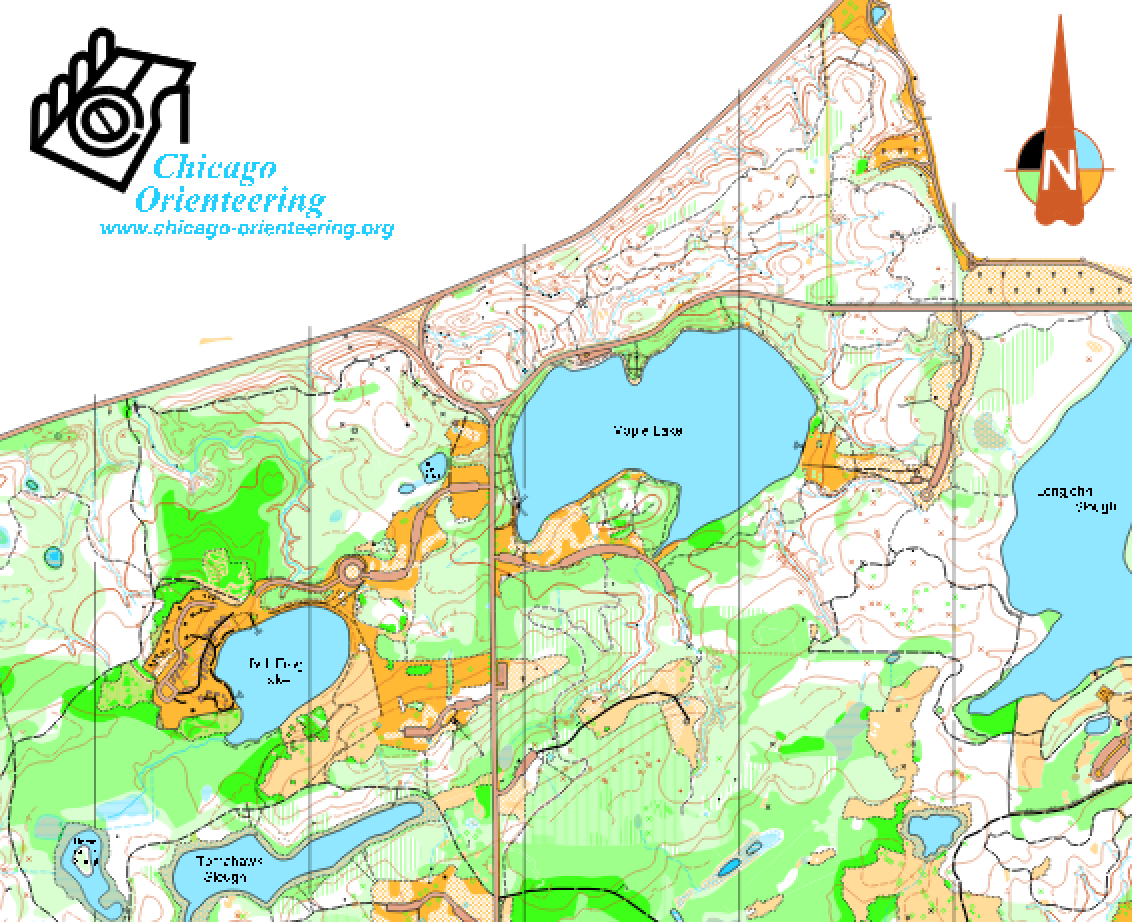
One of the maps we will use for our orienteering trainings in the Spring
    Now that the base of my training program is formed, I can work on the finer parts, such as orienteering trainings. This is completely up to me to do because our club only hosts races every several weeks, so I need to bring it upon myself to plan extra trainings. This year developed a small training group to work with. The group consists of Essi Roininen, a Finnish exchange student who is an orienteer and lives 45 minutes from me, and Thomas Laraia a Junior US Team Member who lives about 6 hours north of us.
    The first part to formulating our trainings is was getting maps from our clubs to use. After retrieving them we are able to pick which ones to use, and figure out where the best areas in each map. After selecting the maps, the second step was to decide which skills each training would focus on.
    I personally need to work on compass bearings while going up hills, maintaining contact with the map in dense terrain, and continuing to keep focused after hard legs in the races. From there we start making courses. Currently this is what we are working on with our coaches. 
    To further understand everything pieces together, feel free to visit my Training Plan and Attackpoint.

Monday, December 21, 2015

Red Bull Canada corporate event

Here's a report about an HPP Fund Raising event that took place early in December in Whistler. The event was organized by me (Adrian) and there were several GVOC and FWOC volunteers including HPP members and current and former national team members and national champions

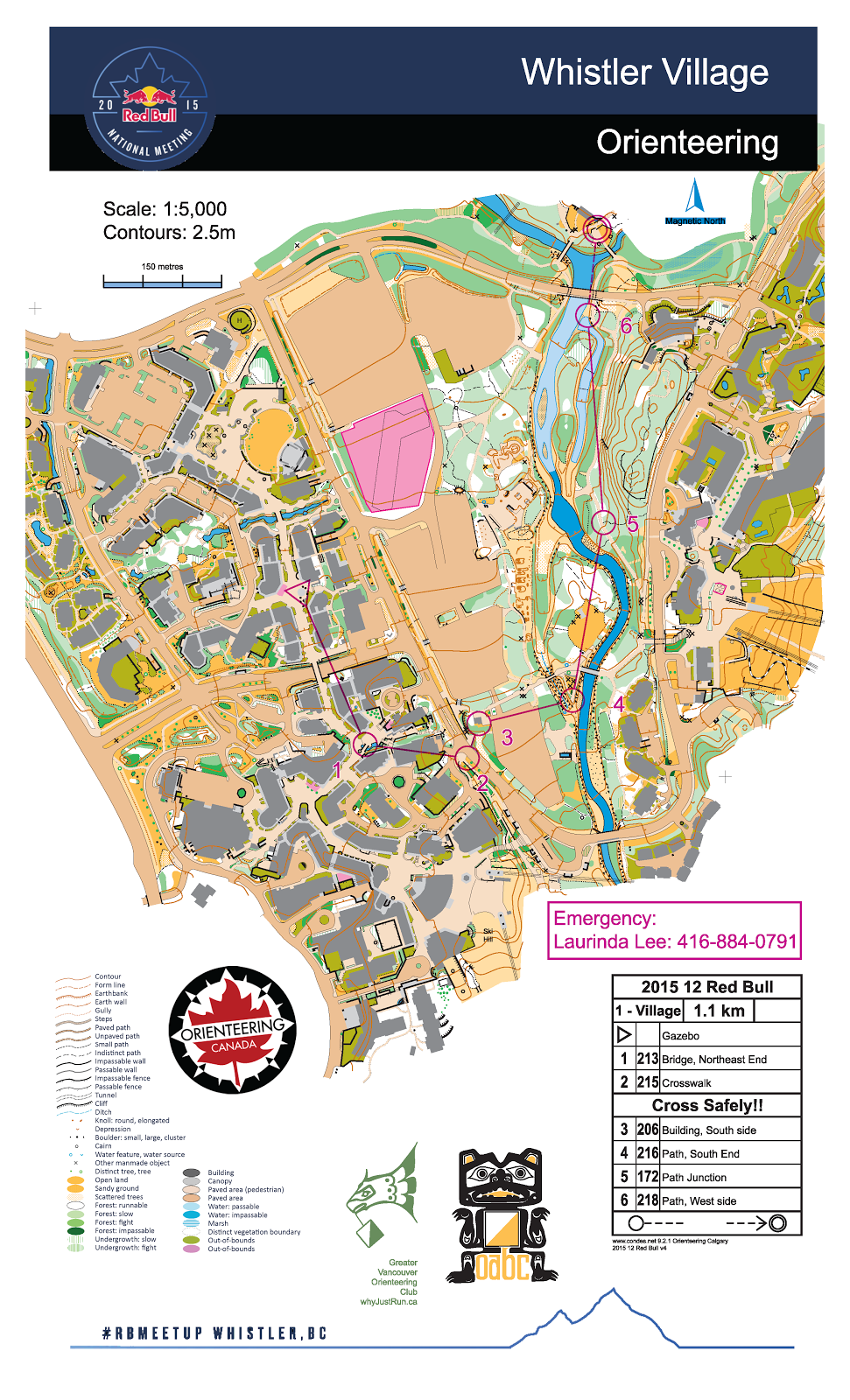
Red Bull Canada was holding a corporate meeting in Whistler and looking for a unique outdoor activity for its staff - to get them outdoors and active. They contacted me and asked if we could do something for them. They were staying right in the Village so we designed a relatively simple course with three legs - the first leg was starting at the hotel and running through the Village to Lost Lake park, the second was in Lost Lake park (on the brand new version of the map), and the third was back through the Village to end at the Longhorns Saloon - where they could download and get a beer in return.

They went out in teams of two. The team members were given to us in advance and we assigned SI sticks. The sticks were given out over lunch time, but with no explanation about what they were. In fact the orienteering was a surprise for the staff - they just knew that they'd be outside and should dress for running and being very active (a message that didn't quite get though to everyone, with rather amusing outcomes). The staff were intrigued by the sticks and to solve the mystery of the afternoon activity everyone pulled out their phones and started Googling to figure out what the sticks were for. 

In any case, the mystery was revealed at 2pm when I got on stage and gave a 15 minute talk about orienteering (emphasizing the speed / endurance / determination / concentration aspects of the sport) and gave an overview of the afternoon’s activities. We had eight volunteers in all – five from Vancouver (Adam, Pia, Graeme, Kate, Ben), one from Whistler (Martin), and two from Canmore (Adrian, Charlotte) - five of these are current or former national team members and either HPP athletes or HPC volunteers. This aspect (National Team, High Performance Athletes) was an excellent fit for Red Bull and the athletes were actually given a bit of an ovation which was nice. The crowd was very energetic (fuelled by constant Red Bull sampling all day) and so the two practice exercises didn’t go off exactly as planned as it was impossible to get them to listen to what we were try to teach them once they were outside ;-) But I think everyone had the gist of it. 

The weather was okay at the time of the race. But the conditions underfoot were still pretty tough - with about three inches of snow that had been rained on heavily for two days making for very slushy and sloppy footing. There were two race options – short and long. More people than expected took the short option – perhaps lured by the enticement of a beer at the download station. But still around 30 people did the long course, going into the Lost Lake forest. Everyone seemed to have a great time, nobody was injured or hurt in any way, and everyone was back before dark. The atmosphere at the finish was electric and several people went out of their way to say how much they’d enjoyed the activity. The stories of the head to head racing were excellent and my favorite was of the team that took the short cut downhill through the forest to jump in front of their rivals - the guy was positive nobody could have been faster because he slid down the hill in his dress shoes- one of those that didn't get the "sturdy trail running shoes" message.

Well everyone went out and came back safely and learned a lot about the “Sport” of orienteering and they had fun. I believe we created a strong and positive impression with Red Bull Canada and have heard nothing but good reports about the event.

We asked that Red Bull Canada have everyone become a member of GVOC for insurance purposes and to generate a little revenue for the club. In addition we asked them to make a donation of $2,500 to the Orienteering Canada HPP - which they actually increased to $3,000. And they paid all volunteer expenses.

Here is the website with results and course maps

Thursday, November 19, 2015

Mind Reps

Over the past few months, I’ve been unable to do any physical training due to a stress fracture. So since I couldn’t train my body, I decided to make the most of it by training my brain. I talked to HPP director Brent Langbakk and he gave me several great mental exercises to prepare me for the orienteering season. Here are some tips to get you started.

For the first few weeks, practice pure relaxation. While sitting up or standing take a deep breath in through your nose and tense up one muscle group (forehead, jaw, neck, shoulders, etc. all the way down to your toes). Then breathe out through your mouth and relax that muscle group. After several sessions, try tensing your whole body at once on the inhale then relaxing your whole body on the exhale. Think of it as a wave of warm water washing over from your head to your toes. After several more sessions of that do the same thing, but don’t tense your body on the inhale, just relax your body on the exhale.

On the exhale say a key word (i.e. relax, nice and easy, etc.). It doesn’t really matter what it is but the idea is to link this word with the idea of relaxation so that when you’re feeling stressed during a race or elsewhere, all you need to do is say that word and you’ll calm down. I did this for about eight minutes once a day.

Once you feel that you’ve mastered this, then it’s on to visualization. Start off with objects around your house, look at them for a bit, then close your eyes and try to visualize them. The shape, colour, texture, weight. Try to rotate them in your mind to look at them from different angles. My room is full of little trinkets and souvenirs so I had no problem finding something. However if you’re having trouble, here are some ideas, a watch, your favourite book’s cover, your pet’s face, TV remote. After about a week of this, try to visualize things outside of your room. A good but challenging thing to try is people’s faces (I find the nose is the most difficult feature to get right).

Some of my trinkets.

Now you finally get to look at some maps! If you can, find a novice course or an urban sprint and just practice visualizing each control circle from different directions. Then add movement, how does the feature change as you approach it? At first the movements may seem to be in slow motion but as you progress, your mind will be able to picture everything around you faster. By the end, aim to have a 1:1 speed, that is, the time it takes to visualize a whole race should be the same time it would take you to actually run the race.

Urban maps are good to start on because the features are generally more organised and easier to visualize, while the features in forest maps are more random.

Complete a few easy courses in your mind then progress to longer, more technically challenging courses. If you would still like to make it more realistic, add other senses such as sound, smell, muscle fatigue, adrenaline, sweat, other competitors, various weather conditions, etc. Add anything you might feel during the race to make it as realistic as possible.

Mental training is a very powerful tool to have because there are no limitations. You won’t get tired or injured from over-training, you can do courses that are halfway across the world, even in the middle of winter you can train.

Monday, October 19, 2015

2nd Annual Calgary Training Camp

I always look forward to the various training camps in Canada. Seldom do we get the opportunity to meet up with other high level orienteers from across this vast nation. Training camps aren’t simply about the orienteering - not to say say that we don’t enjoy that tremendously- they’re a reunion.


Well, enough of the banter. This Thanksgiving weekend was the Calgary training camp held in Canmore, BC. And in Calgary, of course. The event was graciously organised by the Svoboda family, along with the help of Adrian Zissos. It might also be worth mentioning that Ida and Søren Bobach, two world class gold-medal winning Danish orienteers, graced us with their presence as well. I probably should have put that in the introduction.


Friday

(Written by Leif)

It all started bright and early Friday afternoon with a casual, untimed sprint in downtown Canmore. It was a good start to a weekend of training, not too physically or technically demanding. Unfortunately, the map was considerably outdated, and some of the legs had to be cut off due to the decidedly annoying lack of a building (yes, that big one between 10 and 11).


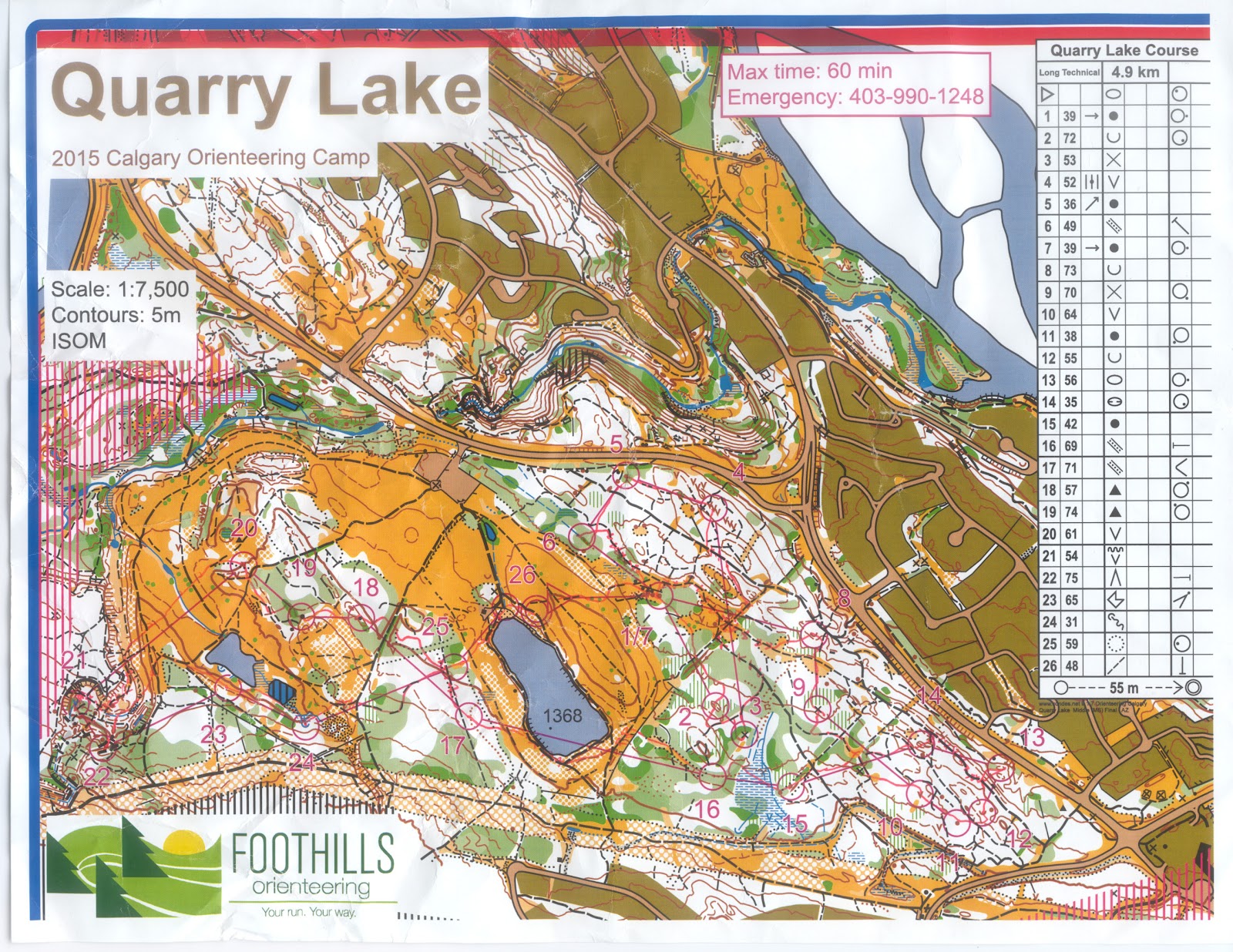
The same afternoon, a middle event was held on the Quarry Lake map close to the Canmore Nordic Centre. As the map was plagued by a number of trails, the overall technical difficulty of the course was somewhat lower than that of the average middle distance, though it goes without saying that I made some errors (refer to route drawn out below). Micro-route choices through the dense clutter of fallen trees proved important to save valuable time.


2015-10-14-0005.jpg


After a catered dinner in the Canmore Nordic Centre Friday evening, we were treated to a talk by Søren and Ida about their training schedules. It was interesting to learn that Ida does not train for more than one and a half hours at a time, as this represents the longest period in which she will actually be racing. In 2014, she clocked in 577 hours of training, though to date her hours for 2015 combine to only 474 (still quite a lot). Søren trained somewhat less than Ida, ranging from 400-500 hours in the past few years. He mentioned that a few years back, he was increasing his training by much more than the recommended 10%, and that it resulted in quite a few injuries, though he added that he generally recovers much quicker than most. Both Søren and Ida have logged more hours of cross training/alternative training than running. Ida’s strength training accounts for about 20% of her regime.


Saturday

(Written by Jeff)

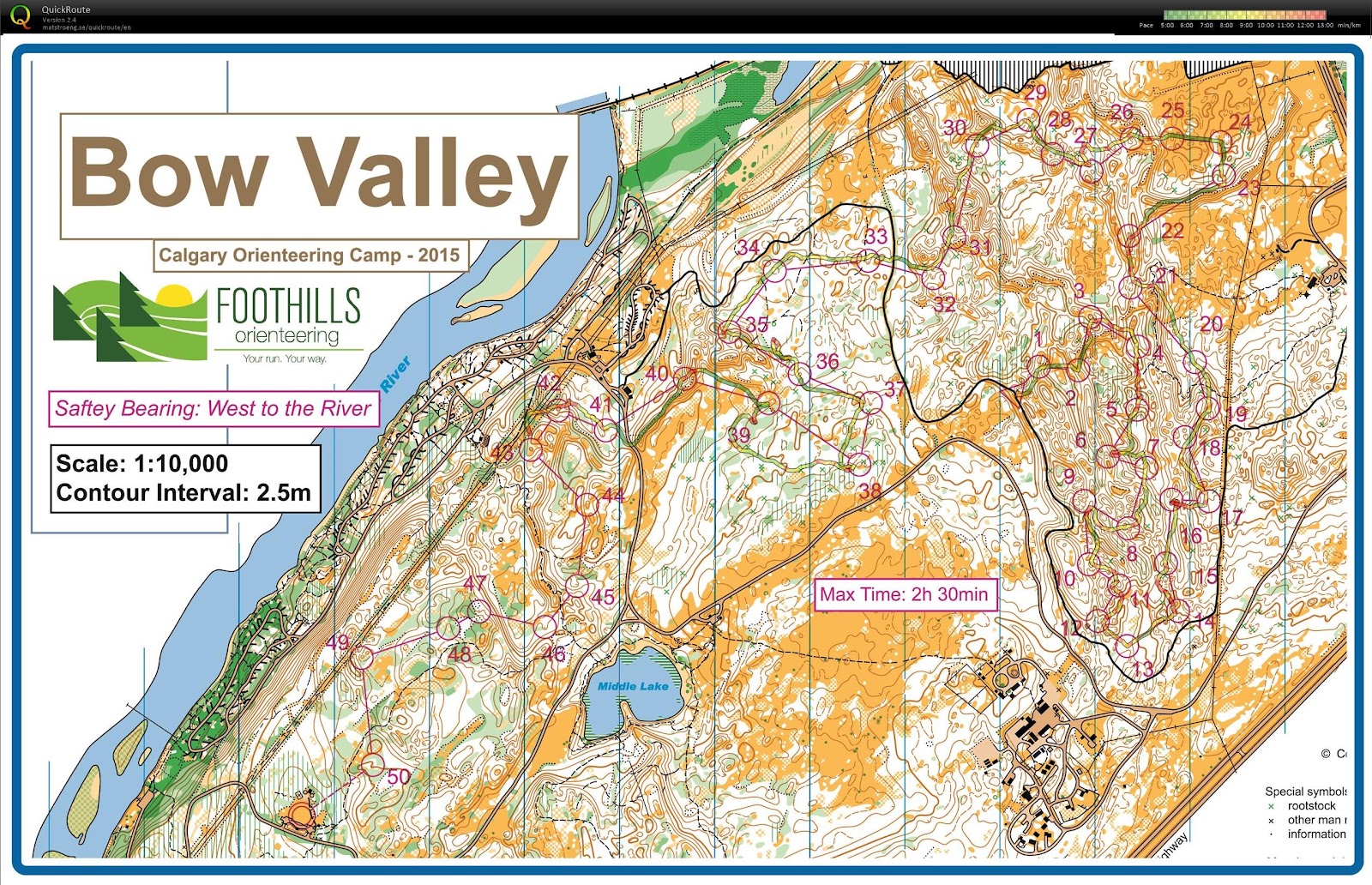
Saturday was the headline attraction of the weekend with the the 50 control ‘middle’ at Bow Valley Provincial park. The day started with a ~3.5 km corridor-O to the start of the ‘middle’: a 8.4 km concentration-fest that Søren and maybe a few others could have completed in under an hour if they were on top of their game and hadn’t added 3.5 km of tricky orienteering to the start of it.. Needless to say it wasn’t very middle-like but it was a ton of fun and good training.


Because of the control-picking style of the course and the technical nature of the terrain you had to stay focused nearly the entire time. With the intricate contour detail, sharp ridges and variable runnability you couldn’t simply set your compass and look up for your next control feature. You had to have a full plan for every leg then focus on executing that plan and not drifting onto a parallel large ridge or tiny depression. Somewhere in there you had to plan your next leg too!


BowValley50ControlMiddle(Final).jpg


My role this weekend was two-fold: first, I was there as an athlete - there was no way I was going to miss this chance to train with Ida and Søren! and second as a coach for my SOGO level 3 athletes all of which, I’m proud to say did very well this weekend!


At the beginning of the day I met with my athletes to provide them with advice and a goal for the 50 controls: The goal is to stay as focused as you can for as long as you can. When you stop being able to refocus after a lapse is when it’s time to quit.


For me it was at control 43 when I had to admit it was time to follow my own advice. Beyond that point I would have simply been reinforcing bad habits. Until that point it went well though (other than the fact that several of my teenage athletes stayed with me for far too long and even beat me to several controls). I blame running 35 km in 6 hours the weekend before with Patrick to win Run the Wild in Cranbrook and not recovering properly afterwards… oops!

Following the 50 control course was a control description exercise where I shadowed one of my athletes. Then it was time to head back to Canmore for a much needed shower before dinner at the Nordic Centre and another talk by the Bobachs.


This time the subject was how their national team and elite training centre in Denmark are structured. Definitely lots of lessons that could be taken away from it - primarily how much all being in the same city and really focusing on being a team makes a difference. Applying here in Canada isn’t so easy of course. We don’t have near the resource they do - a multi-million dollar budget and 2+ full time coaching staff plus access to physio and massage therapists, dieticians, mental coaches, etc. are thigns we’re a long long way from having!


Sunday


(Written by Leif)

We awoke early (early for a weekend at least) Sunday morning to drive into Calgary for the final two sprints of the camp. The first was held on the U of C campus, starting just outside the Olympic Oval. In essence, it was a classic University sprint course. Many large buildings to find the best route around, and a handful of traps, most of them defined by impassable walls (see control #4). Being able to anticipate smaller features like ramps and staircases was also necessary, as missing a turn could cost you your momentum and valuable time.


The final event of the camp was held on the Mount Royal campus. The map had been drawn by Michael Svoboda and American Matej Sebo, and this was its grand unveiling. Contrary to the U of C course, Mont Royal was quite an atypical University sprint map. In the place of large, oddly shaped buildings was an array of modest rectangular residences and interspersed areas of intense detail. The course brought the runner through a variety of terrain, from parkland to miniature pedestrian blocks. Most notable was the section between controls 5 and 8, where we were presented with an intricate courtyard of stairs, underpasses and balconies (See blown up section below). It was one of the most interesting sprint challenges I have ever been faced with.


All in all, it was a great weekend of orienteering and meeting with some of the world’s top orienteers. I got to experience some amazing terrain for the first time, and run some fantastic training. I extend my gratitude to the organisers as well as Søren and Ida for their hard work and effort in making this weekend what it was. I look forward to coming back sometime soon.