Tuesday, February 26, 2013

Vancouver Sprint Camp 2013 and The Home Field "Advantage"

Me Running at Lonsdale
The Vancouver Sprint Camp is the biggest event of the year for my club, GVOC. And I had been looking forward to it for quite some time, though unfortunately for me this was only my second Sprint Camp! I had run on all but one of the maps before, and was hoping that this would help my chances in the new system of having an overall winner for the weekend. Top 5 in men's and women's were to be awarded a prize based on percent behind the winner in 5 of 6 SI timed races. Because of this the weekend turned into a bit more of a racing camp than a training camp though not in a negative way.


So how helpful was the home field advantage? I would say it cost me more time than it saved! in several races I said to myself "I know where that is!" and took off running. Though because I didn't completely analyze the map and realize that although, yes I new where the location was, I hadn't chosen the best way to get there. My best example of this would be my control 18 on the Setup Race at Queen Elizabeth Park.
QE Park Setup Race
For this leg I simply glanced at the map said "Perfect, I just have to cross the small rock bridge (Circled above in Blue) and I'm there" So I put my head down and ran right to the bigger rock bridge (Circled in red).
Because I thought I remembered the other bridge being wood I lost a solid 45 seconds looking in the wrong patch of trees. When all along instead of trying to remember what the park was like, I really should have just read the map. Overall for the weekend I wish I had forgotten all the locations and simply used the map. Knowing Lonsdale Quay might have saved me some time but even here I made assumptions that I know lost me some time on the complicated multi-level sections. Moral of the story - No matter how well you know or think you know an area remember that the actual answers are in your hand!
Lonsdale Quay Sprint Race
Nevertheless Sprint Camp was an awesome weekend. With a verity of  maps, forest, urban, and park, and lots of new challenges; especially multi-level areas like Lonsdale Quay! Even if it was a bit of a race weekend for me there was lots of fun to be had for everyone with the banquets, costume contest, and fun events.

Old O-Suit Costume Contest 
And even though I didn't win the weekend I still won the Super Sprint :)
Fun Bonus Event
For results all the awesome maps from this year and past Sprint Camps check out http://sprint.whyjustrun.ca/
And head out next year for more awesome and baffling sprint races and training sessions, I'll be there :)

Friday, February 22, 2013

Hong Kong Orienteering: Why haven't you been yet?

Much has been said about last month's World Cups in New Zealand, which were attended by many. Unfortunately, the races held in Hong Kong one short week before said World Cups were attended by much fewer. Since so much has been said about New Zealand already (yes, it was excellent, read any number of the other blog posts at worldofo.com about them), I wanted to, albeit belatedly, write a bit about of my experience orienteering in Hong Kong.

First off, to get it out of the way, I will grant that the terrain in Hong Kong will not blow your mind. You will find very little pristine white forest one might expect in Scandanavia. There is quite a lot of very thick green and very thick green. 

With that admission out of the way, I would also argue that if you don't make an effort to go to Hong Kong for orienteering, you're missing out. There is still plenty of maps that have some white forest, some slower green, lots of vast open rocky hillsides, complex urban areas, and extensive trail networks for tough route choice decisions. Not only that, but you're missing out on meeting what I would consider the best orienteering community I've ever encountered.

When I first arrived, I went on a mission to get myself a Chinese Visa. One day later was a race in China, and the Hong Kong association arranged buses for any interested runners to make the three hour trek into Guangdong province to attend. They had three full buses. The race itself was a modestly important race to the Chinese, but was planned by an orienteer from Hong Kong. The map was made less than a month prior to the event happening, the courses with even less time. Nevertheless, the event was (presumably) a success, and we even stopped for Strawberries on the way home. They have a certain pluck and moxie to make these events happen.

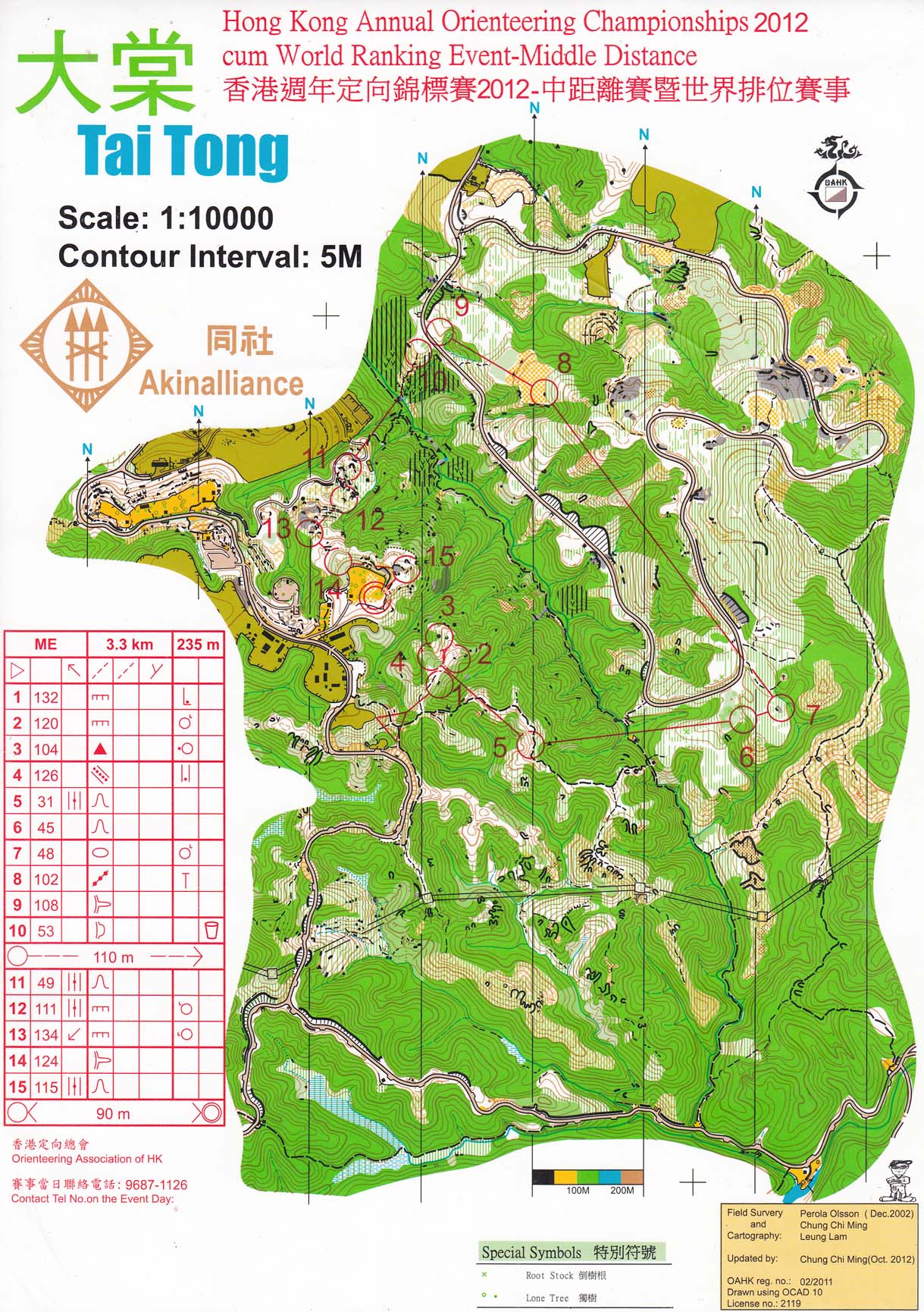
Once back in Hong Kong, I participated in the Hong Kong Sprint, Middle, and Long championships. In all cases, the races were very well organized, and utilized the limited terrain impressively well. The middle, for example, was drowning in green, save for ribbons of white forest and trails. So, the middle was planned to be a) epically physically difficult, b) with some longer, route-choice-y legs, and c) tricky in the few white areas.

No green-crashing necessary.

The white was very pleasant! (Photo by Øystein Kvaal Østerbø)

And once again I want to re-iterate, that, while it may not always be the 'best' terrain, its that its so different that makes it so pleasant. Its what I've repeatedly harped on about China as well. Its may be forest, or park, or urban orienteering, just like we have anywhere else, but its different. It feels different, the forest is different, the character of the terrain is different, this sort of adventure cures your orienteering blues.

There's orienteering in them thar hills. Seriously.
To top it all off, this orienteering is done with the most cheerful group of people I've ever met, and a major part of what made Hong Kong really shine. The people that compete at these events don't necessarily all do it to compete exclusive in orienteering, but because they love competing, period. And adventure. And giving it their all in sport, whether it be orienteering one weekend, cycling the next, epic 50km trail runs the weekend after, followed by a triathlon. And they love to do it together, as a sporting activity, and a social activity. Every event I did while there was followed up by a fun and delicious lunch/dinner before heading their separate ways, until next time, which was usually Tuesday night training, or Wednesday night hills, or the next weekend's event. And they even let big dumb non-Cantonese speaking me come along. It was particularly cool to meet all these people because quite a few of them had already been to Edmonton back in the days of APOC. They've made the effort to come to us. They deserve a similar effort from us.

After the long distance - roasting slabs of meat over a fire? Yes please.

Some of the crew after our evening hill run in front of what is probably the world's finest urban night scape.


Canada orienteering would also do well to learn from our Hong Kong friends on how to promote orienteering. Their national championships was jam packed full of school children, far outweighing the number of adults participating. There are also plenty of orienteering-related adventure-y races not unlike Hamilton's highly successful Adventure Running series. The Salvation Army O! Day in October had 600 participants. They've also partnered with various other organizations to put on orienteering related events, such as the Medicins Sans Frontiers Orienteering Competition

And I'm not quite sure who does them, but the posters they make for these races are amazing. If I saw this, whatever it is, I'd try it:

Where do I sign up?
I'm no graphic designer, but I love this.

In conclusion, I would argue that those people who are really passionate about orienteering are the ones that don't always look exclusive for events that have the best terrain, but rather search for events that offer the best orienteering experience. And when you combine the excitement of a city like Hong Kong, the amazing community, and the adventure of exploring some new and weird terrain, you really can't go wrong for an amazing trip. 

Check out the Orienteering Hong Kong here: http://www.oahk.org.hk/eframe.html

Thanks to awesome hosts Gerald and Iris also! Bad news, I enjoyed myself enough that I'll probably be back.


Tuesday, February 12, 2013

2013 High Performance Program Athletes Announced!


Orienteering Canada’s High Performance Committee is proud to announce 26 athletes to the High Performance Program for 2013. They are (in alphabetical order):
Adam Woods, Coquitlam, BC
Alexander Bergstrom, Ottawa, ON
Angela Forseille, Williams Lake, BC
Carol Ross, Moncton, NB
Damian Konotopetz, Winnipeg, MB
Darius Konotopetz, Winnipeg, MB
Emily Kemp, Ottawa, ON
Emily Ross, Moncton, NB
Eric Kemp, Ottawa, ON
Forest Pearson, Whitehorse, YT
Graeme Rennie, North Vancouver, BC
Jeff Teutsch, Ottawa, ON
Jennifer MacKeigan, Whitehorse, YT
Kendra Murray, Whitehorse, YT
Kerstin Burnett, Whitehorse, YT
Louise Oram, Vancouver, BC
Molly Kemp, Ottawa, ON
Patrick Goeres, Winnipeg, MB
Pia Blake, Whitehorse, YT
Robbie Anderson, Ottawa, ON
Robert Graham, Ottawa, ON
Serghei Logvin, Oakville, ON
Silken Kleer, Lee Creek, BC
Tori Owen, Calgary, AB
Trevor Bray, Whitehorse, YT
Will Critchley, Edmonton, AB
You can view individual athlete profiles (updated for 2013) here. You can also follow the athletes on the Team Canada Blog, on Facebook, and on Twitter@OrienteeringCAN. Please feel free to add comments of congratulations and encouragement to our athletes on any one of these pages!

Tuesday, January 8, 2013

World Cup Sprint and Middle

Time for another update from New Zealand. A lot has happened in the past few days!

Sunday was the middle distance, held in a really tricky sand dune area. They started us of with a few straightforward controls in the forest and then straight into the really complicated dunes, where it was hard to even make a plan to find the control! There were some huge mistakes made during this race!

Monday was the sprint qualification, held on the grounds of the New Zealand Parliament in Wellington. It was a very fun, quite tricky (or so we thought) sprint with some good route choices. Unfortunately, we both missed qualifying for the final, with Will on some 20 seconds out.

Tuesday was the sprint final. We were able to watch the World Cup runners first before running the same course ourselves later. It was fantastic to watch Lizzie Ingham finish with a bronze medal in her home city! We were very privileged to run on the grounds of Government House; the organizers said that was a first and probably a last. Although during the race we barely noticed where we were. This was the probably the most physical sprint I've ever done and definitely the one with the toughest route choices. Have a look at the map and think about what you'd do!


credit: worldofo.com
Today we spent resting and visiting Wellington. We're off to Masterton for a long race tomorrow (not a World Cup) and then the chasing start World Cup in Hawke's Bay on Sunday. Stay tuned!

All maps can be found here

Friday, January 4, 2013

New Zealand World Cups

It's currently -17 in Moncton, New Brunswick, but Will and I are enjoying the sunny, warm New Zealand summer. Yay for sunshine, fresh corn and strawberries!

We arrived in Auckland on January 1st. I just completely skipped New Year's Eve and went straight from January 30th in California to New Year's Day in New Zealand. We were hosted by the very welcoming Smith Family in Auckland for two days, where we had a chance to explore Auckland's sites and a couple park maps.

On Thursday we found a car and joined forces with Helen Palmer (GB) for the drive to Palmerston North. On the way we stopped at the scenic Lake Taupo for a picnic and a run out to Huka Falls.

Today we went and ran the first public race, which was fantastic open, intricate sand dune terrain. It's very exciting; there are so many really fast orienteers here!

Look for us in the first World Cup middle race on Monday. The first start is 9:30am local time which is 3:30pm EST (on Sunday!).

PS: Our favourite New Zealand road sign so far is when entering the town of Bulls: "Have you herd of Bulls ... A town like no udder"!

Thursday, December 27, 2012

Orienteering and Running in Bangkok

For the last 17 months I have been living halfway around the world in Bangkok, Thailand.  While I have been in Thailand I have had the opportunity to introduce the sport of orienteering to some Thai children aged 6-12.  They were very excited to try a new sport that they had never heard of before.  I made a number of courses around the school yard at the school that I am teaching at.  The students enjoyed the challenge and adventure of finding the controls marked on the map.  However; they needed constant reminders to orient the map because they were often going in the wrong direction.  Maybe the World Orienteering Championships will one day take place in the land of smiles!  Here is the first ISSOM map that I know of in Thailand:


Running racing and training in a foreign place where the temperature rarely drops below 25 degrees Celsius can pose some challenges.  For this reason many of the running races here start at 6:00 am. or earlier when the temperature is a cooler 24-27 degrees Celsius.  Running a race when it is 38 degrees Celsius and 46 with the humidity would not be ideal!  There are many running races here in Bangkok almost every weekend and sometimes 3+ races on a Sunday morning.  To date I have entered 33 races during my time in Asia.  I have entered races of varying size and distance from small 10.5 km. races (which are called a mini marathons here) to large marathons in Bangkok, Phuket and Pattaya, Thailand; Beijing, China; Chuncheon, South Korea and Singapore.  The constant with the races in Thailand are that you get at least one running shirt/singlet, a medal, and lots of food afterwards.  Many of the races here seem like a big deal with VIP only seating areas, nicely decorated awards stages, prize money and trophies.
Besides the heat, running the streets and sidewalks of Bangkok can also pose some other challenges that we would never even think of in Canada.  One of these challenges is running on an empty stomach and running past many food carts and restaurants along the road selling every type of Thai food you can imagine.  If you are hungry then there is the urge to stop and eat some food.  Another challenge is dealing with the odd chilli powder in your eye while you are running.  Chilli powder and spices are very prevalent in Thai cooking, so there has been many times where I have found myself ‘running blind’ because of chillies in my eyes!  The street dogs can also get a little crazy after dark.  It makes you run faster when they are chasing you!
There is a nice park fee of food, chilli powder and street dog challenges.  This place is called the Buddhamonthon Park, which is one of my favourite places here in Bangkok.  It is a good place to run because it is quiet, beautiful and there is some shade!  I can also practice some visualization and pretending that I am orienteering here spiking a control behind a large clump of bamboo shoots.  It would make an awesome venue for the next Park World Tour (PWT) race… 


Happy New Year from Thailand!

Tuesday, December 11, 2012

Winter Training


During the winter, it’s especially important to try and keep your orienteering, both physically and mentally, up to scratch.  Since August, I have been living in Norway, and as Norway is the country of orienteering, I have gotten lots of good practice in so far this fall/winter.  I've had a couple of training sessions that were new to me, so I thought I would share them.

The first thing I got introduced to was orienteering inside.  I've actually done this before, but never on such a large scale, and never as a race.  This can be incredibly fun, and the more the merrier.  For those of you with a college or university nearby, I would suggest this!  The idea is to find a building with as many passages, floors, staircases and dead-ends as possible.  Then, you draw a course with as many floor changes, dead-end controls and traps as possible.  And set everyone loose to get confused and run around in circles!

This is a map of one of the
buildings in the local university

It’s also very important to keep running during the winter, even if you are cross-training with skiing, or some other sport.  Long runs can be amazing.  Maybe chose a map that you haven’t run on in a long time, and just run.  If you live in an area with lots of lakes, maybe do a lake-to-lake run, although be sure to check that the ice is thick enough before you cross! 

A group of orienteerers out for a run

These days, you can start running at 11 and still catch the sun rise!
Those who have little to no snow, like those in Trondheim, can orienteer in the streets all year round.  Running can always be a bit more fun when you have a map to run on!  A recent training session here had us running longer legs, corridor style, with small sprint sections of 4 or 5 controls interspersed.

The point was to run slower on the corridor, and really try to
sprint the large circles.  You could not go outside the blue line.
For those not living in a snow-less climate, mental training is important as well.  Here, while we are doing core workouts, we also armchairs read, or remember what the columns in the control description mean, or choose the fastest route.

From my calculations, the shortest routes are:
1,A:2,A:3,C:4,B:5,C:6,C:7,A:8,C
I may be wrong.
I hope that you all are having a wonderful winter, whether full of snow, or not, and that you all continue to have a good year in terms of training!