Thursday, August 4, 2016

OO Cup 2016

Stage 1


     The 2016 OO Cup took place in three different countries this year, with one day in Italy, two in Austria, and two in Slovenia, exposing the runners to a plethora of different terrains. Runners were blessed with very complicated maps for the first two stages of the race which heeded it a necessity for contact to be kept all along the way.
      Personally my favourites, I will go into detail about the terrain type and running style that was exhibited in the first two stages, as each took place in a different country whose terrain varied completely.
      The first day’s course was a neatly constructed middle distance, where a majority of the running was in the complex forest while the rest of it was full of features that made it a pleasure to orienteer in. One long leg with route choice was included that required choosing the trail that one would run on and following it nearly all of the way to the control.


     On the course I had made a total of two big mistakes. One was near the beginning going into the second control and the second was at a relatively easy section as I was attacking the twelfth control. In the first case, I had made a good plan and executed it perfectly up to the control circle, where I misinterpreted the contours and did not have a very strong bearing. This caused me to slow down and veer a bit to the right onto a small hill from where I regained perfect contact of the map. This little hitch most likely cost me a minute of the race. The second mistake that I made was due to a failed speed change, as I ran into a simpler section of the map. I wasn’t in full contact with the map and was coming at the control a little bit high. When I came down to attack then I misinterpreted the scale and came down the wrong wide spur, and landed on the trail. Not knowing where I was I went left along it and cut up from where I could see the very large re-entrant, and could make my way back to the control. I lost a whopping  4 minutes due to that mistake. I believe that I made it because I was a little too high and I didn’t see the re-entrant in the control circle. When I saw a different one, then I had cut down to the right of it, and made the parallel error.

              For the rest of the course I managed to spike nearly every control therefore I must have been doing something right. I’m fairly good at using contours as reference points, and in this terrain that seemed to work very well.  To controls 1, 2, and 3 that tactic worked fine.  Locating 4 was trickier as there is a knoll and a bunch of cliffs in the circle; therefore in that specific case it was again better to look for the obvious re-entrant that it was placed in. A control that required lots of micro navigating would have been 5, where one really had to check off all of the features on the way to the clearing after they got onto the hilltop. After the clearing, I pretty much walked into the control on a hard bearing and with constant verification of features that were on the way, most notably the cliff.  For more complicated controls this technique nearly always worked.
     The transition into the simpler part of the course was easier and gave time for a portion of easier orienteering. At this point I was personally quite tired and had to brace myself for the rest of the course from control 20 – 21. The water control was also very motivating at this point in the course.  For the long leg I stopped, as always, for a few seconds and planned it out where I think that I was able to pick the best route choice.

22 – 25 became a bit of a dog leg, as I chose the same route out that I had taken in. In the last part of the course the most important thing to do was to keep focused on map reading and not to get lazy. It was easy to simplify a route choice too much and end up making a mistake. For the most part these legs were easier than the first part of the course, as there were more trails, and less details.


The Stage 2 map was the highlight of this year’s OO Cup for me.  The course planner didn’t hesitate to get right down to business when it came to it, staring the course off in the hardest section of the map.  On this map, the strategy that I went by was checking off each feature as I passed it, and stopping as soon as I exceeded my map reading speed. This way I was able to finish the course with a sum of 2 mistakes, adding to about 2-3 minutes.

Stage 2
     The Stage 2 map was the highlight of this year’s OO Cup for me.  The course planner didn’t hesitate to get right down to business when it came to it, staring the course off in the hardest section of the map.  On this map, the strategy that I went by was checking off each feature as I passed it, and stopping as soon as I exceeded my map reading speed. This way I was able to finish the course with a sum of 2 mistakes, adding to about 2-3 minutes.

     My first mistake happening on the way to 4, where I exceeded my map reading speed  on a bearing and stopped just short of the control to relocate, this took at least a minute as I stood there before I found the two large cliffs just N of the control.

     After that, I simply continued each leg with a more or less straight plan, which minimized the distance I would have to navigate and run.

     The only other navigational mistake that I made was a compilation of distance misinterpretation, compass laziness, and misreading the terrain.  On the way to 14 I was drawn into an elephant trail that was bigger than the normal trails on the map, and thus I began misreading all of the terrain.  I had also disoriented my map slightly and thus hadn’t been watching my compass. When I was about halfway to the point at which I realized that I was in the wrong spot, I should have noticed that I had gone too far without seeing any green.  Thus my mistake concluded with me cutting left, and relocating then going back to the control from there.
 
     In the detailed sections my orienteering was adequately sufficient to spare me of needing to deal with mistakes. On a leg like 17, I would make a solid plan and execute it nearly perfectly. In this case it was to come around the right side of the cliff on the hill, go on the left of the massive cliff, and on the right of the smaller one, cross the path, between the gap of the two cliffs, then cross the saddle with the rock in it. Just beyond that I knew that there was a clearing from which I could take a bearing noting the rock on the way out, and the slowing down into the area in the re-entrant, and finally finding the rock with the control. Most of the legs compiled of a long sequence of steps like that, in which if you left one out, you could make a fatal mistake on the whole for that leg.


     The last few legs seemed relaxing compared to the constant focus of the previous part of the course, as here you could simplify more and think just more about running.

     Overall the terrain was amazing, and the map was probably the most complex middle distance map that I’ve ever run on in my life.  The course planning was great, and the overall organization of the OO-cup was amazing. This event is one of those that elite orienteers definitely must go to at least once in their life!
 

Saturday, July 30, 2016

WUOC 2016 starts with a bang (of a canon)

Today marked the opening ceremonies of WUOC 2016.  Over the past couple days the team has trickled into Miskolc, Hungary and has explored the gorgeous surrounding terrain.  Most of said terrain is either broad hillsides with small point features or large, very circular collections of deep crater-like depressions.  The woods are (for the most part) very open and fast underfoot.

This year's opening ceremonies took place in Diósgyőr Castle.  We followed a jester to the moat of the castle, where the 'king' and 'queen' welcomed us aided by the firing of a canon.  I think we all jumped a little!  Upon entering the castle, the sound of medieval music filled the air and armored guards lined the passageways.  Once the speeches and raising of the flags was over, a juggler on stilts entertained us for a spell, before we were released back into the (rather boring) modern world.

Tomorrow marks the first WUOC race - the individual sprint.  For those wanting to follow along online, you can visit here.  Emma Sherwood even has a GPS!

Start times (local) are as follows:

Emma Sherwood: 10:15
Pia Blake: 10:25
Robert Graham: 12:04
Damian Konotopetz: 12:32
Adam Woods: 13:07
Robert Anderson: 13:38

Go Canada!

SOW you think you can orienteer!

Swiss O Week (SOW) 2016 took place in the Engadin valley in the eastern part of Switzerland, very near to the location of this year’s JWOC races. Because of this, many JWOC athletes also raced the SOW races, along with some other Canadians. HPP athletes racing SOW included Pia, Nicole, Emma W., Emma S. (me), Robbie G., Jan Erik, Tomas, Leif, Christian and Michael. There were some very good results by Canadians including top 25 results in their respective categories on individual races by Robbie, Leif, Jan Erik and Emma W.

Here’s a picture of Christian getting ready for his race in our the small section of the arena that we’d claimed:


This was a fairly big competition, with about 4000 competitors. Each day, everyone would drive or take transit to the arena and then proceed to one of three starts (as indicated on the bibs). Here are some competitors walking to the arena on the 4th day:


The format of this race series was 3 middle or long distance-type races, a rest day and then another 3 races. My favourite race was probably the last day, which started with some fairly physical legs before a map flip for forking and a more technical section.

Here is the D20 map for the last day. What routes would you have chosen (especially for 2-3 or 15-16)? You can see the route choices of a couple of the competitors including Pia and me here.


Canadians took advantage of the rest day by going exploring: hiking up mountains, wandering through towns, or even going to Italy. It was a really cool area with lots of fun things to do. This is a picture of Samedan, a town where many of the Canadian juniors and were staying.


The Engadin valley also had plenty of interesting orienteering terrain. Some of the days included a variety of different terrain types, such as high-up open, rocky terrain on days 3 and 5. The elevation was over 2000 meters above sea level on those days! Unfortunately, due to potentially dangerous weather conditions people with late starts (including me) did not get to race on day 5. Athletes took a gondola up to the start, and then raced through a very rocky area which had good visibility until the fog rolled in (as you can see from the panoramas that Pia took below):


All in all, it was a very fun week where we had ample opportunity to test our orienteering skills. For me and some other Canadians, it was a nice week too rest and recover a bit for upcoming events but still appreciate the awesome Swiss terrain! Most of the Canadian team is continuing on to other competitions such as the Canadian Orienteering Championships in Alberta or the World University Orienteering Championships in Miskolc, Hungary. Stay tuned for updates on those competitions!

Monday, July 18, 2016

JWOC 2016

Sunday, July 10th, Sprint - Emma W

The morning of the Sprint started with some typical pre-race jitters and the superstitions that Erik informed you all of. (Yes, lucky hairbands really do work!) You could tell that the others were also nervous, but excited to get the day rolling. We all headed down to the town of Scuol to warm-up for our races, and by then the day’s heat was already settling in nicely.

The W20 course was 3.3km, with 85m of climb and a set winning time of 14 minutes (Which was crushed by Simona Aebersold in 13:13!). The course consisted of two sections of technical legs in the town area separated by a long leg. The key here was to plan ahead for that long leg whenever you go the chance. Another good tip that the team had discussed before the race was to look up for obvious features like water fountains or building that stick out more. That way, you can focus on one bigger thing rather than checking off many smaller ones since many alleys and streets looked similar.

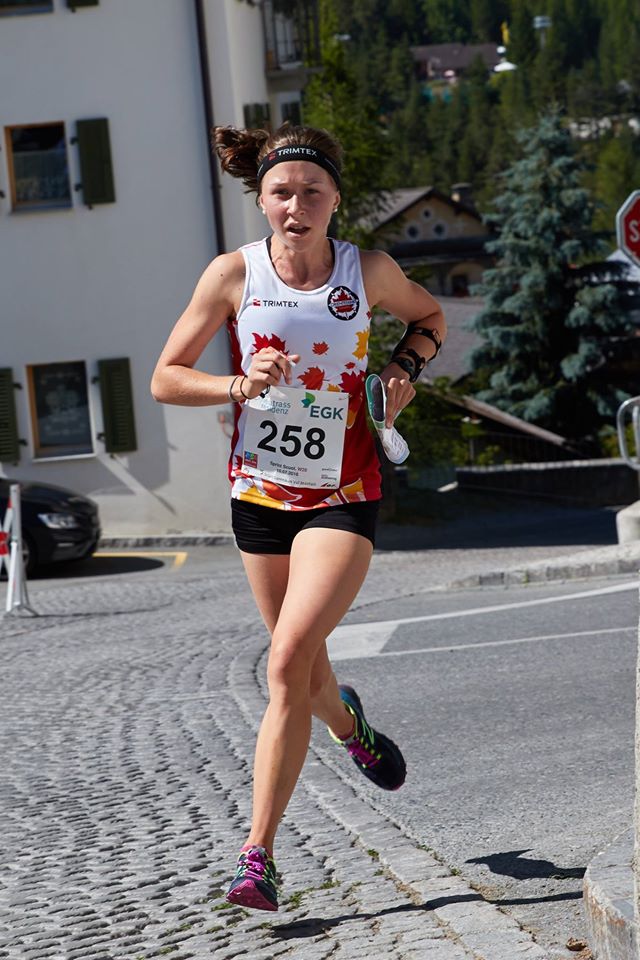
Robbie, Emma and Leif in the Sprint, Photos courtesy of Dave Yee Photography

The route-choice leg was long and had some different options.The park route, which I took was shorter, but had lots of twisting and turning. Which route would you take?  
Courtesy World of O

Exiting the town section, we had an uphill leg from 9-10 where many of us lost a lot of energy. Following that, there was an easy leg to a spectator loop and a map flip. The second map had a few legs in an open park that was riddled with some false fences just to mess with you. Personally, I lost some time in the spectator loop because I flipped my map over too early and couldn’t figure out where the loop shot me out to. After some re-focus however, I got right back into it and tried to tell the burning in my legs that it was almost over.


The Canadian boys did well with the top placing for Robbie Graham in 111th place with the best % behind the winner for Canadian men since 2013. For the women, I held a similar placing to last year in 30th place (compared to 28th in Roland!) and the others put in some solid places.

Read more at
And

Monday, July 11th, Long - Leif

Monday began at 5:00am with an early breakfast and a 2.5 hour journey to the quarantine, high up in the Fuorn pass near the Italian border. The previous night's chills beginning to fade, I set out on the 8.8km course across open pastures and daringly steep hillsides. With 450m of climb at an altitude of 2200m, the winning time was set at a surprisingly long 70 minutes for such a short Long.

The course started in a rather technical but open section of the map, with some detailed contours and some opportunities to lose some time early on in the race. For me, it was a matter of easing into the terrain, not taking too fast out of the start chute, and keeping absolute control of my navigation as I headed through to control 4.

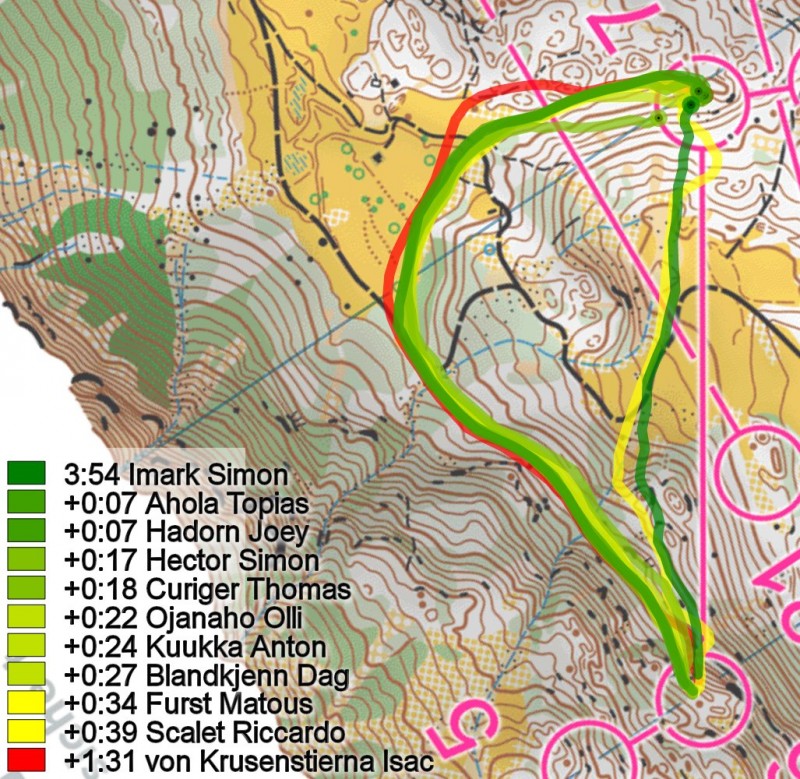
From there, the course alternated between physically demanding long route choice legs and short bursts of highly technical contour navigation. Leg 7, shown below, gave approximately equal times to both routes, though staying high to the left most likely would have saved power for later on, of which I could have definitely used. A common trend in faster route choices, even on shorter legs such as 18-19, were detours into the open fields, where running was much faster than over the rocky forest floor. The long leg to control 10 brought the M20s far down the hillside, giving way to the promised 450m of quad-burning climb.
Courtesy World of O


The Canadian men all finished within 03:25 of each other, spanning a mere 14 spots in a field of 156 finishers. In the end, the 70 minute winning time was beat by nearly 5 minutes in a very impressive run by Joey Hadorn. The women were not quite so close together, but they did walk away with some better results. Emma Waddington finished in 78th - her best JWOC Long result to date.

and

Wednesday, July 13th, Middle Qualifier - Leif

A cool morning gave way to pouring rain as athletes competed for one of 60 spots in Thursday’s Middle A-Final. Starting about 150m up the hill behind our accommodation, the three men’s courses weaved down the hillside (albeit with 150m of climb), ending in the adjacent football field (European, mind you). The course ran through technical rock and contour areas, as well as long slopes where a good bearing, accurate side-hilling and an awareness of what features to spot up ahead were critical to successful navigation.


It was a short and fast race, with winning times of around 25min and an A-Final cut-off of about 30min. A little too fast out of the gate, I lost about 1.5min on the first control, ending up too high above the control. After, I managed to run a clean race, keeping up a good running speed and simplifying effectively to avoid getting bogged down in the detail, finishing 1:09 behind qualifying.

Pia Blake ran exceptionally well, qualifying for her first time in the A-Final. She was the only Canadian to achieve this level of performance in the Middle in 2016.

More info & maps:

Thursday, July 14th, Middle Final - Emma W

After another chilly evening in the mountains, we made our way to Susch-Lavin for the Middle Final. Canada had several of our athletes in the B and C finals, who started before our one and only A finalist, Pia. After a long, uphill walk to the pre-start, I headed off on my B final course of 2.9km with 180m of climb.

The race started by throwing you right into a fairly technical area. The second leg was where many other girls had trouble since it was slightly downhill and sidehill with nothing too prominent to catch you if you went too far. They key here was to be careful and not descend too many contours. I took this leg cautiously and nailed it! Here, I caught a girl from New Zealand and we ran the rest of the race by taking slightly different routes and meeting up again. The majority of my course was pretty clean navigationally so that was a pretty rewarding after a not-so-great run the day before.


The course then played around on the top of a small plateau for a while, with lots of small features. The woods were incredible open, and the footing was quite forgiving to the ankles. (My ankles thank you, Susch-Lavin)

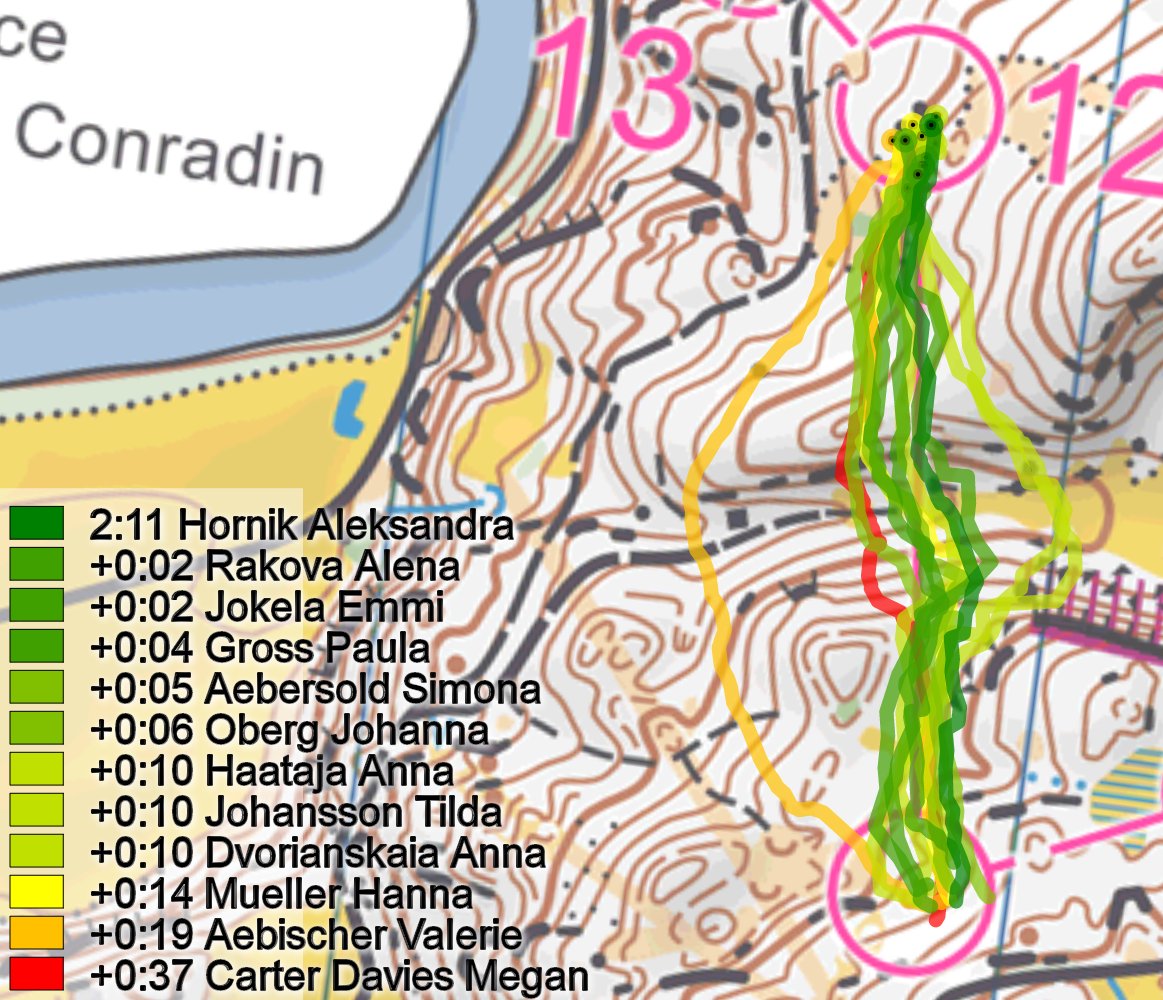
Then came a routechoice leg that was common between the A and B finals. I opted for one of the green routes, which was a pretty solid route.
Courtesy of World of O

Finally, the course descended into the arena only to go right back up into the woods again for a short little loop before punching GOat control into the finish. Nope, that wasn’t a type-o. It really was a goat.

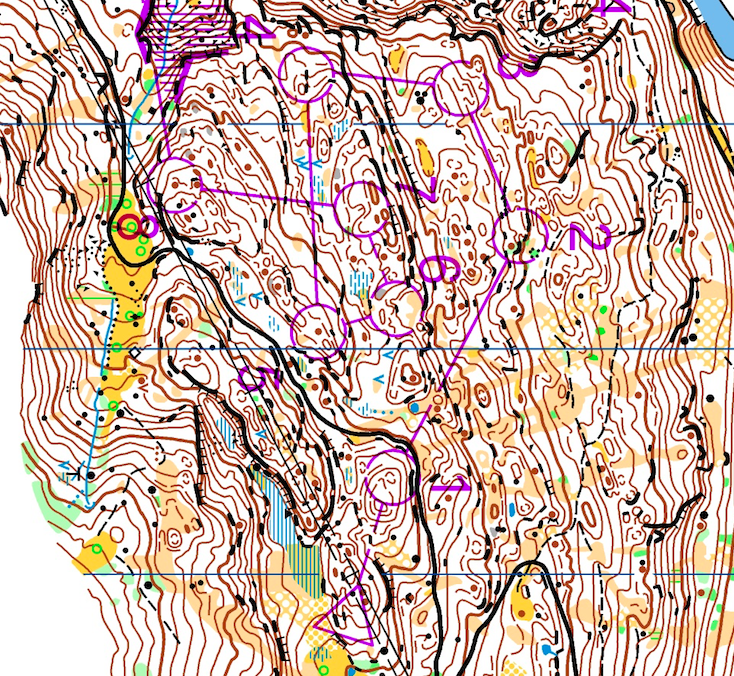
Control description: South-eastern foot.

Both Michael and I had personal bests in the B final, placing 17th and 10th respectively.

It was also fun to watch Pia, our superstar A finalist, on the big screen and follow her GPS along. Everyone was cheering!

Pia looking happy with her race!

For more, visit
And

Friday, July 15th, Relay - Emma W

Now for the fun race! It all started with some face paint by Emma S... (A+ art skills, Emma...truly…)


Jan Erik approves of his face  paint!


The boys race started at 10:30, and Jan Erik led off our A team, and Michael led off the B team. Both boys put in solid first legs, with Jan Erik coming in 20th, and Michael in 40th. After lots of team spirit and great runs by Leif and Robbie, Canada 1 finished 22nd! Christian and Caelan led Canada 2 to finish 34th, both large improvements from last year!

The girls race started at 11:15, with me racing the first leg. Right off the start I was feeling the hills from the previous races in my legs, but the adrenaline was too high to stop! Our third leg had a huge hill that most of the girls were trudging up, it wasn’t that enjoyable.
Killer, right?

For the rest of the course I managed to stick with the middle pack, and finish in 18th with a time way under what I had predicted! After a terrible first leg last year I was incredibly proud of this result!

Both Pia and Nicole had similar feelings about the hills, but we all agreed that the relay terrain and course was fun and enjoyable, and a great way to end the week in 36th place!

Go Canada!

And

Thanks to all who supported and watched us throughout the week of JWOC. It meant a lot to all of us and helped up along the way! Thanks to our coach Jeff for always giving us helpful tips and training techniques. Thanks to Sabine and Erik for keeping us on time and getting us where we needed to be. Thanks to the o-store for getting all of us our race gear and Icebug Canada for some great shoes and Trimtex for our great Team Canada uniforms!

See you next summer, at JWOC 2017 in Finland!

Wednesday, July 13, 2016

Q&A #1 with the JWOC 2016 team members

In the leadup to JWOC 2016, team members were asked a number of questions about orienteering, and here are some long-anticipated results of the survey.

Caelan just floating on sunshine
As you all know, there are two main punching systems for orienteering: SportIdent and Emit. JWOC 2016 uses SportIdent, so the burning question is "How do you hold the stick?" Almost the entire JWOC team wears the SI stick on their index finger (left or right), and most wear it on the side so they can grip it with their thumb when punching (does anyone remember the Sass Peepre jingle "Thank you Pippa, 7 seconds faster..." from the 2004 COC banquet in Whitehorse?) A few people wear the stick on top of their index finger. But we have one outlier, and that's Caelan who wears his stick on the side of his middle finger. Here's the photographic proof of his heretical style (oh, and the cool sunglasses are always on, sort of channeling Cory Hart).
Don't mess with Emma S!
Robert stepping out!
Scanning for that next control!
Team members also have a few interesting rituals and talismans. Pia always gets her shoes wet before a race so that she has no hesitation stepping in water for the first time. She also likes to wear a red hairband for Canada. Emma W wears pearl earrings to help channel her inner Scandinavian. She also has a lucky hair-tie, and has a ritual of untying and retying her shoes before each race. Robbie prefers his short shorts and an unwashed sweatband (too much information, really!)


Nicole is in control!
Emma W makes it look easy!


Pia cruising on by...


To close, the JWOC 2016 team has some words of advice for up-and-coming orienteers:

Tomas: "You should never compare yourself to others. Everyone is different. Some have to work extremely hard just to get a minimal benefit, but skills may come naturally for others. You should be your best, not somebody else’s best."

Leif: "Just get out on maps as often as you can, and challenge yourself to navigate through complex terrain."

Pia: "Experience as many types of terrain as possible, even if it is just visualisation of terrain via maps found online."

Robert: "Don't over-train and injure yourself. I am of course speaking from experience."

Emma W: "Take any opportunity you get to make new friends, and enjoy yourself!"

Michael: "Train hard and remember to have fun!"

(all photos courtesy of Robert Svoboda)

Sunday, July 10, 2016

JWOC Sprint is over; preparing for the long tomorrow.

Despite weather reports calling for rain in the late morning, today was a hot sunny sunny day. On the plus side, everyone had dry cobblestones to run on, but on the minus side it was a very hot day, particularly for those starting later.

Emma W had the best Canadian finish with a 30th place finish followed by Robert in 111th. There were also solid first-time performances by Christian, Nicole and Leif. Both Emma S and Jan Erik improved their running times over last year.

There are several pictures of the Canadian runners on the JWOC photo albums pictures from the Terrain and pictures from the Arena as well as on Orienteering Canada's Facebook page, courtesy of Nick Barrable from CompassSport magazine.

Robert Graham exiting the spectator loop

We've had our team meeting for the Long tomorrow, which involves a delicate dance of assigned buses, trains, walking, and more buses as we head to a sequence of 2 (or 3) quaranteens Val Müstair. Robert will be the first starter of the day at 9:01, which means that he and Jeff are leaving our accommodation at 6:05. Breakfast is at 5:30.

If you are up early (or very late), you can watch the Team Canada twitter feed on #jwoc2016can

#jwoc2016 #orienteeringcanada

Saturday, July 9, 2016

JWOC Training Camp Days 4-5

Click the picture to read about the fourth and fifth days at the JWOC training camp and follow along with what team Canada has been up to here in Switzerland!