Sunday, May 29, 2016

4th at European Champs Middle!!!

I can hardly believe it myself! And to think that last Friday I was sprawled on the floor in Stockholm airport for the second day in a row seriously considering giving up and trying to get a flight back to Turku. Arlanda airport turned into complete chaos when the air traffic control system broke down and flights got cancelled left, right and center. Part of the British, Hungarian team and I found ourselves at the mercy of Scandinavian Airlines waiting for hours to be rebooked just to have our flight cancelled again. It certainly felt like I was never going to make it to Jesenik but a ginormous thanks to the British Team who delivered me sane and in one piece right to my accommodation at 3:00am… 44 hours after leaving my home in Turku.


Beautiful terrain waiting for us in the Middle Qualifier. Photo: Will Critchley
A week later I’m standing at the start line of the middle final and incredibly happy just to be there! We were expecting a tough race technically as well as physically and we definitely weren’t disappointed. We were thrown directly into a steep, rocky hillside with vague vegetation to try and survive the first few controls with minimal time loss. If you’ve seen the photo on the Orienteering Canada Facebook page you might be wondering why it looks like I took a bath in a mud pit. The start triangle was in a marsh and as I was running through I tripped on a stone and sent a wave of muddy swamp water up into my face. Cue frantically trying to wipe it out of my eyes in order to read the map!

Up to the 6th control I had quite a few hesitations in the circle when I didn’t have concrete attack points and was therefore playing my luck to recognize the features in the circle and see the flag. It wasn’t the technique that I was going for but at least I was able to stop in the circle, fit the map to the terrain and find the control from there.

Photo: Iveta Malá
Tove Alexandersson was starting 2 minutes behind me and I heard the first crackle of branches at the 6th control but resolved to keep my focus ahead no matter what. She came roaring through at the 10th control and there was no keeping up with that train! Physically I was not feeling at the top of my game and it was everything that I could do to keep pushing despite the burning in my legs and my lungs. It really felt like I was at the limit of what I could do physically while still keeping my navigation together. I was walking that fine line between running an aggressive race and running into oblivion. Which is why I nearly got lost going to the go-control (Will agrees that it was surprisingly difficult).

Photo: Iveta Malá
My objectives for running these European Champs were to get a feel for delivering good races under high pressure and to see how I compared to the best in the world. This result is super positive feedback and I can keep training with confidence knowing that I’ve been doing something right this year so far. I even got the interesting but exciting experience of having my very own awards ceremony after the EOC podiums. When you find yourself alone beside the podium just smile and wave!


We wanted to take this opportunity to thank all of the EOC organizers who worked so hard to put together such a great week of racing. Challenging races, beautiful terrain, team leader meetings with no funny business, rides from the arena back to the quarantine to pick up our car, unlimited water for when I had to go through doping control… we’ll certainly keep many fond memories from our time in Jesenik, Czech Republic.
Photo: Léa Vercellotti

Wednesday, May 25, 2016

European Orienteering Championships - A Few Big Hills

Team Canada arrived (mostly) in the Czech Republic last Thursday to get in a little bit of preparation before the first races on Sunday. I say mostly because there was only two of us that were expected to arrive, and one of us most definitely did not. For several days. In short, Emily got stuck in an airport.

With that crisis eventually averted (though narrowly re-crisis’d when we discovered that the hotel locks us in and I was unable to open the door for her at 2:30 in the morning) we managed to get out to a model map for the long the day before the sprint. If you haven’t run in the Czech Republic before, find your nearest hill, run up it many, many times. And maybe jump through a little bit of stinging nettle every now and then. That is a Czech orienteering simulation. 

The forest is actually really lovely. Tall trees and basically no low branches means the white forest is wide open, super runnable, and the visibility is miles and miles, except for that giant hill in the way. Occasionally there are also cool and fun rock/cliff features, though this terrain didn’t have as many as further west and north in places like Novy Bor (see “Czech out those rocks!”)


Alas, this is not our hotel. But it was the sprint final area.
The first race up was the sprint, which I (Will) was the only Canadian running. I was aware that my fitness was not where I wanted it to be, and I seemed to have also picked up a bit of a cold after pulling an all-nighter at Tiomila the weekend before (lesson learned). So, for me, the sprint qualification and subsequent B-final were just opportunities to create good habits and to work on running with relaxed form. The sprint final was a particularly fun race, held on a hillside spa, which meant big hills, many stair cases, a few switchback roads, and ambiguously mapped flower gardens & shrubs!

The fun thing about sprints on maps like these, though, is the difficulty in finding effective route choices when legs go straight up or down the hill or when the legs go across the hill. The ability to plan as much as possible with brief amounts of downtime becomes super important, since you need to be able to both choose a route quickly, but also choose the correct route! I… did not.  Unless the best route included stinging nettles. With short shorts.

At this point, I was tied for 1st place! (photo by Petr Kadeřávek)
In the long distance qualification, we were met with the added challenge of having very hot weather, hovering around 25 degrees. Perfect weather for standing around and watching runners suffering in the heat.  Personally I did not have a strong heat, as I was still feeling the cold and by 2/3rds through the race, I hit a new level of tired that transcended just "race tired" and more into “I’d just like to lay down for a while”.

Fortunately, Emily was more than capable to pick up the torch that I apparently forgot in quarantine and run a strong qualifier, progressing into the A-final. In the long final, thanks to her qualification position, Emily had the opportunity to be starting in the midst of the top runners in the field. By the end of the long A-final, with many racers slowly dropping off the pace, she ended up a remarkably strong 7th place. I asked her to provide her own report on how the race went:

I was feeling calm as a cucumber before the race. I knew that I knew what to do (and that rhymes, too! – ed.), so it was simply a matter of going out there and executing.

When I first picked up the map I saw that the first few controls were quite short, which was good, but it also meant I didn’t have as much time to plan the route to four, which was a very long leg. Route choice is essential in this terrain because a wrong route choice could mean climbing way more than is necessary. So, to be safe, I made sure I left the control quite slowly to plan my entire route, which was a worthwhile “investment” of my time. There were quite a few big trail running sections as well, so I used that time to plan the rest of the course.

Emily melting faces. And just plain melting. It was hot.
Physically, it was difficult because of the nature of the terrain. It was quite rare to be doing anything other than going steeply down or steeply up. So it either felt like you were going “too slow” or “too fast”.  But, in spite of that, I was feeling pretty good. At around 2/3 through the race I took a gel, but I didn’t really feel like I needed it (even though in retrospect, I’m glad I did).

A quick look at the results showed that a lot of runners were really falling off the pace in the last 15 minutes of the race. Although physically I felt good, I could tell that my concentration wasn’t as high because I wasn’t executing my plans the way that I should have, and I was more trying to “fix” them as I was finding myself in the wrong spot. But it just turned out that I could be flexible with my route and still get to the control with minor time loss.

I’m quite happy with this result, but there are still things I need to work on to get me to the level I want to be!

----------------------------------

Next up for Team Canada is the Middle distance, which goes down tomorrow (Thursday, May 26). The starts are in the afternoon, and Emily will be wearing a GPS, so you can watch her dot at http://www.eoc2016.cz/en/ . You can simulate Will's dot by taking a lazer pointer and shining it against a wall in a random pattern. 

Thursday, April 21, 2016

2016 World University Orienteering Championships team announcement

wuoc2016_logo_300x144
Orienteering Canada’s High Performance Committee (HPC) is excited to announce the Canadian 2016 World University Orienteering Championship (WUOC) team.

The World University Orienteering Championships are held every 2 years. This years championships are in Hungary July 30 to Aug 4.

Canada will be represented by:
Robbie Anderson
Pia Blake
Robbie Graham
Adam Woods
Eric Kemp
Damian Konotopetz
Emma Sherwood

The team will be coached by Brent Langbakk.

WUOC is organized by FISU (International University Sports Federation). Canadian Interuniversity Sport (CIS) works with Orienteering Canada to coordinate Canada’s participation in the championships.

Orienteering Canada is grateful to the selection committee members: Adrian Zissos, Wil Smith, Ted de St Croix and Magali Robert.

JWOC 2016 team announcement

JWOC2016

Orienteering Canada is pleased to announce the selection for the 2016 team to attend the Junior World Orienteering Championships in Switzerland in July 2016.

The athletes are:
Pia Blake
Emma Sherwood
Emma Waddington
Nicole Whitmore
Leif Blake
Robert Graham
Caelan McLean
Christian Michelsen
Jan Erik Naess
Michael Svoboda

Alternate: Tomas Graham
The alternate can be inserted if one of the selected men have to withdraw due to injury before the start of the competition.

The team is made up of both juniors who have raced in JWOC before, as well as younger athletes new to the world scene.  These athletes have all shown their interest in competing for their country and have shown the dedication needed to start or continue on this journey.

Orienteering Canada is grateful to the work of the selection committee: Stefan Bergstrom, Ross Burnett, Katarina Smith. The selection process details are outlined at orienteering.ca/team-canada/high-performance.

Go Canada Go!

Wednesday, March 9, 2016

Things I learned from start of the season racing

So far in 2016, I’ve competed in two weekends of racing: the Vancouver Sprint Camp and Desert Run.  In both events, I did some things well and some things not so well. I had good races and not as good races. Since they’re at the beginning of the season though, I can learn a lot from them, particularly about where I can improve, and therefore what I should focus on during my training in the next few months leading up to more important races. As it has been a little while since both of these events, I’ve had enough time to reflect on them.
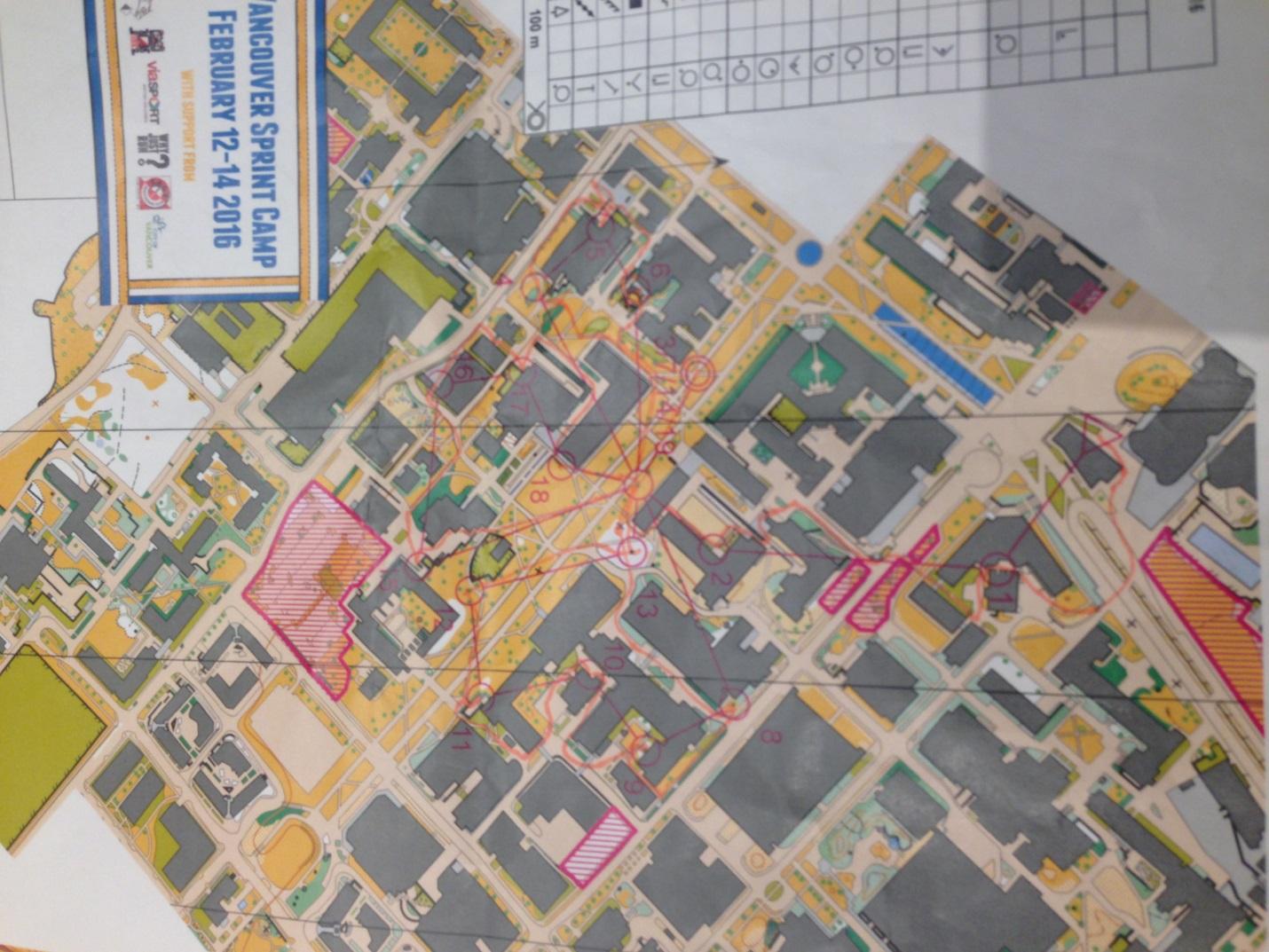
For me, the first big races of 2016 were Sprint Camp’s series of 5.  As the name suggests, these races were all sprint-type short courses on a single weekend. The first one was at Queen Elizabeth Park:


I took this one too fast at the beginning. I was overly excited to run my first race of the year, and I wanted to have a speedy race. Unfortunately, this led me to be too imprecise in my planning. For example, going to control 2, I thought to myself something along the lines of ‘get onto the concrete part below the round building and take stairs down towards the control’. Because I wasn’t precise enough about which stairs to take, I started going down the wrong ones and ended up losing more time backtracking than I would’ve lost with another map glance and adding to the thought ‘the stairs at the end of the concrete bit’. There were also some other instances on the course where I made similar mistakes, but one thing I think I did well was my flow through the controls from 9 on wards.  This makes me think my planning improved throughout the race.

The mass start of the Elite Men at a race on Saturday (Photo: Meghan Rance)

To prepare for the next races, I reflected on the race at Queen E Park and so my goals in the next couple of races were to plan in advance more completely. I think my orienteering certainly improved because of that goal. I learned to not let the hype of the races allow room for costly mistakes and that sometimes taking a couple seconds to look at the map can save more time than it took.
Not surprisingly, I orienteered much better the last day of racing. This included two exciting races on the UBC campus (my home turf, currently).  They were a set-up and chase format, with the chase being looped.

C:\Users\WIN7PA~1\AppData\Local\Temp\IMG_0255.JPG

(Sorry for the bad quality photo)
I started the chase a bit easier because my calves had been bothering me and focused on clean navigation. It was a mass start and the first loop went cleanly navigationally for me except for a bobble due to my misinterpretation of the map at 5 (there are stairs under the canopy). Then, after the first loop, I started accelerating, being pushed by the thought of running my best race (against the others who had started with me) but still being completely ‘in the zone’ and thinking about navigation.  I ran all out until the end and finished with probably my best results of the weekend even though I’d taken the first part a little easy. Reflecting on things I didn’t do as well in the first races of the weekend allowed me to do better in the last ones.

HPP members at the 2016 Vancouver Sprint Camp (Photo: Marsha Fehr)
(Left to right: Damian Konotopetz, Michael Svoboda, Jeff Teutch, Jan-Erik Naess, Jennifer MacKeigan, Christian Michelsen, Emma Sherwood (me), Leif Blake, Pia Blake, Adam Woods, Emma Waddington, Tori Owen, Graeme Rennie and Coach Brent Langbakk )

The second set of races that I attended a couple weeks later was Desert Run. This was a two day event in eastern Washington State where I opted for the middle distance course the first day and the long course the second day (see Pia’s blog post about it here: http://teamcanadaorienteering.blogspot.ca/2016/03/a-bit-of-blue-sky.html ). The first day I really struggled with interpreting the terrain and rushed many of my first controls which caused me to have some poor route choices at the beginning and even to have to relocate once. Once I got into the map, after about the 7th control, things went a bit smoother. I think this demonstrates the usefulness of practicing on maps with similar terrain before big competitions. I had raced on some similar terrain before; some of the maps in the middle of BC have some similar features but that was a while go.  Additionally, having not raced in a while, I should have taken the first control easier and worked on remaining calm and focused at the start of the race. I failed to do so that day. At control 6, I told myself to refocus, a skill l that I like to think I’m improving at, and things generally got better thereafter.

The second day, I planned to remain calm at the beginning and take it a bit easier and I did. The second leg of the course was a long route choice leg. As I had not had time to plan it during the short first leg, I paused to quickly look at routes and quickly picked a good one. Although I was still figuring out the map, because there were a lot more interesting cliffs and rock features then the day before, I think my pause to plan was beneficial in the long run because I navigated cleanly (even if a little less speedily then I would’ve liked) to control 2.(Course: http://www.5z.com/urban/gadget/rg2/#150&course=1 )
I was very happy with my advance planning and route choice for the rest of the race, but not necessarily running speed until nearer to the end. When I was approaching the 17th control, a bunch of fast orienteers caught up to me and my speed improved quite considerably. The seemingly head-to head racing made me run faster. Learning from this, I would like to try to always have the ‘you’re trying to beat this person now’ drive to go faster as long I'm in control navigationally. As an orienteer, although I don’t necessarily see the competition the entire race, its still there and should still push me to orienteer at the top of my ability for the entire race, not just when I see competition.
The gorgeous race terrain:
In general, even though these races were all quite different, there were some similar themes throughout that are important for me to try to work on before my next races:
1. Don’t let the stress of the races cause you to go too fast at the beginning and make mistakes.
2.    Taking a second to plan/ map read can save you from mistakes later.
3.    Remember it’s a race/ treat it like you’re always running against someone (but don’t neglect map reading because making mistakes loses more time than slowing down to map read).
4. Learn from mistakes made in the first races of the series to improve in the next ones.
Although I’ve certainly all heard these things before, these races gave me real experience with those learning outcomes so that I myself believe them to be completely true and will work hard to avoid making mistakes like these in the future.

Friday, March 4, 2016

A bit of blue sky

After a couple months in Vancouver, I was hankering for some good old forest.  This past weekend, I may have gotten off the sprint map, but not necessarily into woods.  Instead, I got the chance to run on some one-of-a-kind terrain in Eastern Washington: grasslands!

Saturday morning opened a bit chilly, but there was a gorgeous blue sky. The terrain was very open, with a couple of marshes near the finish, but the rest was grassland interspersed with little patches of trees.  This meant that there was little in terms of route choice, but a lot of looking up and sighting ahead with the trick being to look for the big features.  There were also some interesting rock features.

A bit of bright blue sky

Would you go north or south from 6-7?
I felt pretty confident with my race.  It was my first time in a while on a non-sprint map, so I took the first couple controls to get into the scale and the mapping.  I found the contours to be sometimes difficult to read,  so I ended up sighting up for cliffs and forest clumps: very helpful in keeping me in line.

Results: http://obasen.orientering.se/winsplits/online/en/default.asp?page=classes&databaseId=40740&ct=true and route choices: http://www.5z.com/urban/gadget/rg2/#149

Driving to day 2 we encountered a beautiful sunset
Day 2 was another gorgeous day, with some incredible natural walls that made for very interesting route choice.  Like day 1, the terrain was very open, but unlike day 1 it was impossible to run in a straight line.  This time, compass was of the utmost importance, as figuring out where you were after getting lost was made all the more challenging by a lack of distinct features.  

How would you go from 1-2?
This race started out ok, and going to number 2 I decided to take a route that did not involve too many cliffs and direction changes.  Fairly pleased with that leg, I made an error going to 3: I ended up coming off the cliffs in the wrong place, and as a result made a parallel error.  From there, I decided to be extra careful, and rest of the race went by with relatively smooth sailing.


A couple of the 'natural walls'

Can you guess which control on the long course this is?
A big thank you to all of the organisers - it was an amazing experience, and I am definitely looking forward to going back!  Thank you too to the Woods for making it possible for me to get there.

Wednesday, February 17, 2016

Sprint Camp 2016

Last weekend was one my favorite orienteering events, the Vancouver Sprint Camp.
The event attracted a dozen HPP athletes and 115+ participants. Thought the weather didn't entirely cooperate, the rain made the two person relay a more memorable experience.
Results (and some of the maps) can be found here.

Putting on an event of Sprint Camp's quality involves a ton of effort.On behalf of the HPP, I'd like to thank all those involved in putting on another great Sprint Camp:
Event Director- Alison Schoenhardt
The Coach and Presenter - Brent Langbakk
Organizers - Brian Ellis, Marg Ellis, Karen Lachance, Bruce Rennie, Kate Knapp
Controllers - Louise Oram, Thomas Nipen, Magnus Johansson, Meghan Rance
Course Planners - Stan Woods, John Rance, Robyn Rennie, Mike Rascher, Hilary Anderson, Ben Smith

This it is not a complete list, so to all those I've forgotten, Thank you.