Monday, April 22, 2013

Recovering from injury

I have recently injured my ankle again but this time I am being a lot smarter about it. Last time I had this injury I rested it for a week and ran, played volleyball, basketball and soccer on it. It took me a long time to trust my ankle again well I was orienteering, instead of focusing on route choice and attackpoints I was think don't roll my ankle even thou it was taped. I was also stupid and didn't see physio till 2 months after I was injured.

This was in the Juneau airport waiting to go home


This time around I was playing soccer in Juneau, Alaska and went over on it but I was smart as soon as I got home I was icing and elevating it multiple times a day. I went to emergency to make sure I didn't brake it and luckily I didn't. I was on crutches for 3 days and elevating and icing. I took it slow when I got off them. I started off walking and progressed into running, I did trying swimming but I am a sinker not a floater.

This was 2 days after I got back


I had trouble trying to get a physio appointment but I got one a lot sooner this time. The physio told me I can't run which is a huge pain in my rear end but also smart because I was compensating for my ankle well I was running. I was hurting my back and my right hip. The nice thing is she gave me alternatives so I can keep up my cardio. She also showed my how bad my injury is when I thought it was nothing. She also gave me great exercises to help get full rotation back and start strengthening the muscle.

This was about a week and a half later


Injuries are hard to deal with. Some parts of your body might be saying yes you can do this but other parts might be saying no this is bad stop. It is always good to rest the first few days after an injury I have found and go see a physio to see what you have damage because you might be surprised with what they find. I thought my injury was just some muscle in my foot but it turned out to be a lot worst and know I am on the road to recovery and I am doing it the smart and right way this time.

Tuesday, April 16, 2013

Orienteering Canada Announces the 2013 Rising Star Awards


Orienteering Canada’s High Performance Committee (HPC) is pleased to announce the 2013 Rising Star Award recipients. The Rising Star Award is an annual award designed to support Canada’s most promising young orienteers in their quest for top international results. The nominees are assessed on past results, future potential, and contribution to the orienteering community, as well as financial need.  
Our female Rising Star for 2013 is Emily Kemp. Originally from Ottawa, Kemp has been living and training with the French Elite Orienteering Squad, Le Pole, in St. Etienne, France for the past 2 years.  Kemp had a breakthrough season in 2012, culminating in a bronze medal in the long distance race at the Junior World Orienteering Championships (JWOC); Canada’s first ever medal at JWOC! Kemp is the current Canadian Champion in the long and sprint disciplines. As well as being tirelessly available for media interviews after her bronze medal win, Kemp has also inspired up and coming Canadian orienteers by participating in Skype training sessions and volunteering at the annual Sass Peepre Camp, a camp for 10-20 year old orienteers from across Canada.
When asked what this award means to her, Kemp said, “I am extremely grateful to win this award since it will be a ginormous financial aid for running the world cups and world champs this year. A humongous thank you to the HPP (Canada’s High Performance Program) for helping me and other athletes take orienteering in Canada to the next level!”
Our male Rising Star for 2013 is Serghei Logvin. Logvin had notable results at the North American Orienteering Championships in 2012, including achieving silver in the long distance race, and running the anchor leg for the winning Canadian relay team. Logvin has been very active with the Adventure Running Kids (ARK) program in Hamilton, ON, inspiring up and coming junior athletes. Logvin is currently training in Europe with the specific goal of improving his orienteering.
"Spending quality development time in Europe is a very important piece in the puzzle for me towards reaching my potential”, said Logvin. “The Rising Stars Award will make it a lot easier, both short, and long term. I really appreciate the support, and know that my best results are still yet to come! Thank you!"
You can follow Emily and Serghei through the 2013 orienteering season:
Emily Kemp Athlete Profile


Please join us in congratulating Serghei and Emily!

Thursday, April 11, 2013

Orienteering Canada appoints Toni Louhisola as Canadian National Team Coach


Orienteering Canada’s High Performance Committee is delighted to announce that Toni Louhisola has been appointed as the volunteer Canadian National Team Coach for the World Orienteering Championships. Toni will work with senior athletes selected to represent Canada at the World Orienteering Championships in Vuokatti, Finland this summer.

Toni brings a wealth of coaching experience, including 4 years as Lead Coach for the Great Britain National Orienteering Team. He is a level 3 coach certified by the Finnish Orienteering Federation. Toni was ranked top Finnish junior in 1996, and ranked in the top 20 orienteers in the world in 2004.

When asked how he feels about this appointment, Toni said, “Personally I am looking forward to working with Team Canada HPP athletes, volunteers and Canadian orienteers and clubs and I hope to have a lasting positive impact on the development of the athletes and to help drive the sport forward in Canada. I hope we can all enjoy the journey. I have a holistic approach to coaching but the focus for this spring and summer is to challenge the athletes and coaches to strive towards more effective orienteering thinking, and to contribute to a culture of systematic technical training, feedback, and analysis.”

Toni will travel to the Canadian team selection races in May. From there he begins a 4 week tour of Canada, with stops in Ottawa, Calgary, Cranbrook, Canmore, and Vancouver. Toni will have the opportunity to work one on one with many of the Team Canada athletes, as well as local junior and recreational club members. For more information on Toni’s schedule, please contact Adrian Zissos at Adrian@barebones.ca.

A full profile ofToni is available on Orienteering.ca. 

Please join us in welcoming Toni to the Orienteering Canada community. 

Go Canada Go!

Friday, March 29, 2013

Ski Nationals in Callaghan Valley

Hello everyone!
Here is an update from Callaghan Valley! I have been here for a week now racing at the 2013 Cross-Country Ski Nationals, along with fellow orienteers Darya Sepandj and Adam Woods.

It has been beautiful all week, with the sun shining and beautiful skiing. The first race was a team sprint, where two teammates each ski three laps tagging off each lap. The race is essentially interval training and a great way to start off nationals. For orienteers the comparison would be running a multiple loop relay tagging your partner after each loop. Next on the agenda was an interval start 5km skate technique race. A five kilometres race is a very painful race (at least for me), as it is short enough that you must push every second of the race. This is very good mental training as one must be able to focus on technique and pushing yourself through the pain. The next day presented a different mental challenge. It was a 10 km classic race starting at 11:30am. Starting that late in the day meant the snow was super slushy and was only getting slushier the farther into the race you got and the more tired  you got. The challenge was then forcing yourself to keep moving when your body was on the verge of overheating and exhaustion. Although skiing does not employ the same amount of mental skills as orienteering there are definitely transferable skills. Next was the sprint. 1400m done 4 times. Sprint days are by nature tough and this one was no exception!

Now onto orienteering related stuff: where we are staying in Pinecrest, between Whistler and Squamish, near Brandywine Falls, there is a taste of spring in the air. The snow is rapidly disappearing and the forest is reappearing. This combined with the fact that I was in this area for Barebones is getting me excited for the new season to start. I can't wait to start running through the forest again! I am not sure what the conditions are in Ottawa, but I am sure that when I return, there will be lots of orienteering to be done!

Monday, March 25, 2013

Settling in with OK Linné

-->
Greetings from Uppsala, Sweden! This is my new home, at least for the next three months. I have taken the semester off from university to travel, enjoy life, and most importantly, to orienteer! So far my journey has included a month in Spain with my parents, doing competitions and trainings organized by sun-o.com (an orienteering travel company, who set up training centres, organize event entries, and even lead a 3-day orienteering tour through Morocco!). I then relaxed for a few days in London before attending a competition in Denmark, and finally heading over to Uppsala, where I have now settled in with a lovely host family.

I chose to come here because I wanted a place where I could train with others on challenging terrain, as well as gaining the cultural experience of living in another country. And if I want to orienteer abroad, why not go to Scandanavia, the homeland of orienteering? OK Linné, the club that I have joined here in Uppsala, has many fast, young orienteers, including other foreign orienteers who have come here to train. The club is very active, with scheduled trainings 3-5 days per week, plus a “training bank” on the OK Linné website, where members can post their own training plans so that others may join in. All of this makes it a great group to be a part of.

The club has a full schedule!


There is plenty of forest in and around Uppsala; the terrain is basically flat with marshes, open forest, and many small contour details. It looks very challenging to navigate.

I had my first taste of the terrain last Tuesday, when I attended the popular “Tisdagbana” (Tuesday course) – a mass-start, night line-o. We jogged to the start as a group, then suddenly everyone took off! I tried to keep up with the other girls but eventually the group dispersed as people went at their own pace and split off in different directions for different course lengths. It was mostly on trails and paths, with some sections through the terrain. This made the navigation fairly simple, especially since I was almost always with other orienteers, so my goal was just to keep up with whoever around me (avoid ending up alone in an unfamiliar, dark, cold forest!).

This week's Tisdagbana routes.


Everything was covered in snow, so features didn’t show up very well. I had a blast though. Running with others both allowed and motivated me to run faster than I would have on my own.

After the training we returned to the clubhouse (they have their very own clubhouse!) for an informal social gathering and snacks. There seems to be a lot of “club spirit” in OK Linné.

The clubhouse (photo by Erik Melin, from www.oklinne.nu)


Another perk of training in Sweden is the extensive number of events. There are local and regional competitions basically every weekend, if you are up for a little travel (which is quite manageable compared to travelling across Canada for events). I will be jumping right in with a training camp next weekend in Blekinge, in the south of Sweden. I will travel by minibus with 17 other club members, for a relay, two individual races, and four trainings (5 days).  The camp should be jam-packed with orienteering goodness, and I look forward to getting to know my new club-mates too.

It is exciting to get to experience a new side of orienteering by training with such a large (and high level) club. I have been lucky enough to travel to a diverse range of orienteering events throughout Europe and North America over the past few years, and I find that each new experience gives me different perspectives on the sport.  As my dad has taken to telling me, “you are a sponge.” Each new event or training has an effect on me. I have been learning by exposure – to new terrain types, to new ways of training, to elite competitors, to complicated looping and forking systems, to travel and accommodation procedures, …the list goes on. It has also been a lot of fun to orienteer in different settings. So even though it is a bit scary for me to be in a new place now, trying to make friends and find my way around, I trust that I will enjoy my time here, as well as expand my skills and experience.


Monday, March 11, 2013

Night-O at Burnt Lands


Last fall I got the chance to experience the other side of orienteering that I haven’t really been a part of, the mapping and course setting side. It was very interesting to see what this side was like, and actually personally see how much time and effort goes into making this sport possible.


The area that I mapped is Burnt Lands Provincial park. The park is about one square kilometer but is a very unique area known as an alvar, which is an area with a very thin layer of soil above a limestone plain. Most of the area is very flat with short grass with areas of exposed rock, as well as some marshes and ponds. The area was a military ratio station in the past which left behind a high barbed wire fence that encircles a large part of the map, a small deserted building, and many concrete bases that once supported the radio towers.

Most of the mapping of the area could be done from aerial photos but when I had to get out of the house to field check, getting to the map was not a problem as it is only a 25 min bike ride away which also counted for a bit of physical training. I enjoyed the mapping as it was like creating a work of art but it took up of many, many hours of sitting at the computer which is not my favorite thing to do.


Once the map was finished I thought I might as well organize a race there. With the area being as open as it is the visibility was so good that running there wouldn’t be very challenging. So I decided to organize a night-O which would make it much more of a challenge, and we could always use more night-Os. I though it would be even more fun with a mass start so that’s what I did, using a butterfly loop for forking. The course setting took much less time than the mapping but was still a task to set  course that uses the terrain well, is interesting, and challenging, which I hope I succeeded in doing.


The evening of the race was a bit chilly but was otherwise a great night for a run. I was talked into racing it by the Ottawa elite guys to give them a little more competition  so I did. Even though I made the map and set the course I found it far from easy, it was like a entirely new area at night. At the end though everyone seemed to enjoy it and gave them a good challenge which is always good to hear.

Now that I have experienced this process of mapping and course setting I can appreciate all the time and energy that goes into making this great sport possible to compete in. Now I need to find a new area to start mapping.


Saturday, March 2, 2013

A break from the snow


This past week, I was in Turkey in the Antalya region.  The first few days were spent as a family, hiking in the surrounding mountains and exploring ancient ruins in the area.  However, once Wednesday rolled around, we met up with Camp Norway and had our first training session.

We had a few problems getting to training Wednesday, as we drove through small coastal villages on roads little more than dirt paths, and not sure where we were.  However, orienteers that we were, we finally arrived.  My fears of being very, very late were quenched-we were the first there, and the course setters were not even back from setting the course.  By the time we actually got going, there were a few buses, and a few busloads of people.  I instantly got confused, or overwhelmed, by the sheer amount of detail on the map.  The first few controls were touch-and-go, and I managed to confuse myself quite satisfactorily.  I also learnt-going to number 3-that green was on all accounts to be avoided.  The thorns on the bushes were about 1-2 cm long, and, if you were sprinting past at full tilt and one of them happened to brush against you, you would be drawn to a complete and sudden stop.  Trying to fight through it was not much easier-after the first meter, I gave up with multiples scratches on my hands, arms and legs.

The biggest thing to consider was that the map was most likely done during the dry season, and this was the wet season.  For most of the course, we were running through ankle, knee and sometimes even waist deep water.  At the beginning of the course, I was hesitant about getting my feet wet-by the end, I felt more comfortable running in the water than out.

There was water from control 9 to control 20
The next morning we woke up bright and early for the first middle of the competition series.  The sun was shinning and the woods were open and full of trails.  I had issues with number 1...and number 3...and some others as well.  Needless to say, the race did not go quite as I had hoped it would.  

That afternoon, we headed into the nearby town for a model event.  The first part was spent running through narrow alleyways-all the time getting strange stares from local people going about their normal days.  I was stopped by a policeman who wanted to know what I was doing running along.  Unfortunately, he didn't speak any English and I don't speak any Turkish.  He attempted to question me for about a minute with me not understanding a word until another policeman (who did speak English) was able to clear up the situation so that I could continue on my way.  The next section of the course was the most exciting-running through an old ancient set of ruins!  The eroding walls and prickly bushes made for interesting navigation.

Unfortunately, one was unable to
stop and admire the ruins while running
Friday was the day of the sprint.  I was feeling a bit more confident about the sprint than I had been about the middle.  The terrain was very similar to the middle, and I told myself that what I had to do was keep contact with the map and run as slow as I needed to in order to maintain that contact.  As I ran, I saw lots of people running around looking very lost.  Luckily, I was able to hold it together and crossed the finish line feeling pretty good about my race.  

This was a pretty good sprint for me!
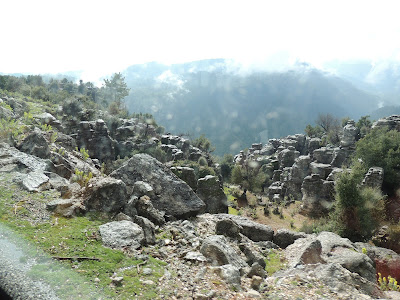
Saturday morning was an early rise for everyone.  I got on the bus at 7 in preparation for a two hour drive up the mountain.  The bus was going up the hill at about 20 km per hour, almost stalling on each hairpin corner.  We arrived in this small, rural village based purely on agriculture.  Even there, ancient ruins were everywhere.  We passed an old amphitheater on the way to the start and most of the race took place on terraces, in use for centuries.  The most exciting part of the race was through a maze of stone pillars, and one could get easily confused.

A stray bull got into the finish shoot
Some of the rock pillars, as seen from the road
My map for the long 
That evening, we didn't have any training to give us a bit of a rest for day four: the last middle.  This one was on the side of a mountain and was played out on large spurs that extended down into the finish area.  Once again, the forest was very open in white and deadly once you hit green.  Of the whole race, the finish shoot was most likely the hardest part.  It was long, up hill and the sun was shining with no clouds in the sky.  That afternoon, our training concentrated mostly on taking it slow and orienteering technically to the best of our abilities.

The woods, although open and planted in rows,
had lots of underbrush that made for slow running
Monday was our last full day in Turkey, and we made the most of it with two last training sessions.  The morning was an opportunity to explore even more terrain and the afternoon was taken up by a simulation of a relay, with forking and mass starts.  Finally, it was time to say goodbye to T-shirts and sun and to head back to the land of snow.

Check out the results at: www.orienteering.org.tr/antalya-o-days-results.aspx?v=3