Thursday, August 10, 2017

Racing In Canada's Capital for Canada 150

Nationals 2017 - Ottawa 

The Sprint - Emma Waddington

The first race of the Canadian Championships was the sprint which took place in Perth Ontario - a lovely little town just outside of Ottawa.

JWOC coach Jeff Teutsch was the course setter for this race, and he set some very interesting courses, all including some residential streets, some park areas (complete with a river crossing!), and even some busy downtown streets with lots of spectators. The atmosphere in the arena wasn’t lacking any energy, that’s for sure!


Screen Shot 2017-08-08 at 6.00.49 PM.png
A sample from course 4 - the river crossing. 

Tori Owen in the river crossing - Photo by Willie Carroll


I ran the women's 21 Elite course for all of the races at COCs this year, but for the sprint it was particularly exciting because I started just 1 minute ahead of teammate Emily Kemp! It was a pretty stressful situation to start in, but after spending this whole summer training and doing sprint races in Europe, I knew that I was prepared to handle anything that got thrown my way.
Overall, I had a really good run! I executed all of the things that I wanted to during my race, and I was able to push hard. I lost some time in the park section, especially on the river crossing, but finished strong to take 3rd place overall and 2nd Canadian!


Screen Shot 2017-08-08 at 6.11.09 PM.png

An interesting route-choice on course 5. Would you go left or right from 9 to 10?

The winner of the F21E course was Alva Olsson of Sweden, who ran the course in 14:31. 34s behind her was Emily Kemp. The men’s 21E course also had some fast times with Damian Konotopetz taking gold in 14:41, with Team Denmark’s Andreas Boesen coming in second only 29s behind.

36237371241_f8976cf8d8_o.jpg
Jr Team member Christian Michelsen and HPP member Graeme Farrand in the finish - photo by Adrian Zissos.

The Middle - Robert Graham 


All the forest races took place in the Foley Mountain Conservation Area, near Westport, Ontario. The terrain was a mix of bare rock/clearings on hill tops, marshy areas, and open forests. The area of the map used for the middle had a lot of rough, rocky ground underfoot which either slowed you down or wrecked your ankles… Sometimes both.

Routes of the first loop on course 10, lots of rocky ground right from the get-go. Eric Kemp in red, Leif Blake in Blue, Brian May in green.
I found it difficult to navigate using the open areas so I mostly relied on land features like contours and form lines since they were a lot more distinct. The rocky ground, though difficult to run on, was actually very well mapped and good for navigation so on many legs I ended up running just to the side of it.


An example of the open areas on course 9. The yellow on the map was a mix of short grass and bare rock.
I talked with Eric Kemp after his run and he said he had a perfect race. Only one minute behind Danish team member Andreas Boesen and 3.5 minutes ahead of Damian Konotopetz in 3rd place. A phenomenal result!

Eric sprinting into victory – Photo by Willie Carroll


 The Long - Emma Waddington


Sunday was the long race at Foley Mountain, the same area as the middle just the day before. Today, however, incorporated another section of map that was completely different than the rocky section that we ran on in the middle. This new section on the north of the map was flat, very runnable, and had a lot of open rock, marshes and small lakes. There was also another new section of the map that reminded me of the Dundas Valley in Hamilton - just some white forest and contours… my favourite!

Screen Shot 2017-08-08 at 6.48.57 PM.png

A sample of the terrain, blown up to a nice and easy to read 1:10000 scale.


This race was my first time racing F21E in the long, and although it was intimidatingly the longest race I’ve done so far, I was super excited to get out there and run. My goal was to take my time on the first control and get into the map. I chose to take a slightly longer route here along the trail, but it gave me time to focus and get used to the scale of the map. (You can see my route on routegadget)

The rest of the race was solid. Only a few small bobbles here and there. I felt like I was running faster than in the middle from controls 3-11, but once we got into the rocky stuff again I definitely slowed down. The nice open forest from controls 13-15 was very lovely until I got a big huge stick stuck through my shoe and right into the arch of my foot. OUCH! I hobbled the next control or two but still tried to push hard to the finish. After taking off my sock I realized that yeah… there was lots of blood… no relay for me on Monday because of this but happy with placing 2nd Canadian and 3rd overall!

One thing this long race was not short of was long legs. And I mean LOONNGGG legs. Here’s a sample from course 10 - leg 6 to 7 with route by Eric Kemp (red) and Robbie Anderson (blue).

Screen Shot 2017-08-08 at 7.05.47 PM.png


As far as results go, the women’s elite was won by Emily Kemp in 66:27 followed by Alva Olsson in 71:20. Jennifer MacKeigan took 3rd Canadian result, just behind Cecilie Andersen of Great Britain. However, Leif Blake of Whitehorse who raced at JWOC this summer, managed to edge out Emily to win the course in 65:51!
The F21E Podium - Photo by Willie Carroll

On the men’s side, Damian Konotopetz put in a solid race and managed to take the gold in M21E, but only 3 seconds ahead of Andreas Boesen! Eric Kemp took 2nd and Robbie Anderson took 3rd Canadian on this 11.3km course.
Leif Blake - winner of course 9 and Mens 20E - Photo by Willie Carroll


The Relay and HPP Fundraiser - Robert Graham


The relay was a ton of fun. It took place in the north-west part of the map where there wasn’t so much rocky ground which made the pace a lot faster. My plan was to get out of the gates quick and hold on the fast guys for as long as possible. The faster guys got away from me after the first control but I was right with Christian Michelsen when we both overshot our second control, oops! We both recovered quickly and soon joined a pack with Eric Kemp and Leif Blake. It was close and the four of us were exchanging the lead for the rest of the course. So close in fact that at one control Christian took a dive to try and be the first to punch causing a bit of a pile up. I managed to pull away in the last two controls and hand off to my Irish teammate Jean O’Neill in third place.

On your marks, set, go! – Photo by Willie Carroll
Emily Kemp managed to finish the 1st leg in just under 15 minutes! Which was about 5 minutes faster than the second person to come in. With a 3.5 km leg 1, she would have run at about 4:30 min/km which is fast even on the road. Turns out she had run the shorter 2.5 km leg 3 by accident. Luckily, they just switched the maps for her teammates, Avery Irwin and Nicole Whitmore from DGL, and no disqualification was necessary.


Emily handing off to Avery – Photo by Willie Carroll

There was an award for overall winning teams as well as some funny awards too such as youngest team (45 years combined age), oldest team (214 years!!), and greatest age difference within one team (50 years). All us HPP members appreciate everyone participating in the relay. Big thanks to course setter Stefan Bergstrom and everyone else who helped to make it happen. See you next year! 

Thanks from the HPP! – Photo by Willie Carroll

Head on over to Willie Carroll's website for many more awesome race photos!


Scottish 6 Days ~ My first ever international podium!


The Scottish 6 Days was a great start to my training year in Norway. After coming back from a post-JWOC recovery week I was excited to have the chance to race hard at another large international competition!

Read my blog post by clicking the link or the picture: Link

Friday, August 4, 2017

Re-living the rhyme Canada went to World Games

Every four years, the world of the sports that gaze through the supposed pearly gates of the Olympics come together to say "Hey, we're cool too!". Orienteering is a member of this exclusive club, and myself and three fellow teammates, Emily Kemp, Tori Owen, and Damian Konotopetz, and intrepid team leader Marg Ellis headed to Poland to represent Canada at the World Games. I've asked each to summarize their experiences of a particular event, before I go into more detail.

In limerick form.

The World Games - by Will
Canada went to the Poland World Games,
Orienteering lots and seeing weird sports were the aims.
Though long bus trips and running real fast,
Meant they executed the first but not the last,
Culprits like "sore legs" and "rather be napping" were their names.

The World Games week consisted of three races, a sprint, a middle, and a sprint relay. In general, the aim of the World Games is to make the races visible, easy for spectators to follow, and in easy to reach areas. Again, sort of thinking forward to the Olympics. How do you come up with races when the area is decided for you? What if the terrain is not the best terrain you have? How do you make it interesting for spectators? What if you are in a place that does not have any orienteering tradition? Although these are debates that will no doubt go on forever on the topic of "Olympics - Yay v. Nay", the World Games are an opportunity, in a way, to try those things out. In Poland, this is quite fortunate, because they seemed to have plenty of decent sprint terrain, and a forest that, although not their best, was pleasant and interesting.

Regardless of those issues, these sort of events are a pleasant change because generally everyone is on even ground. We all stay in the same accommodation, we all take the same transportation, we eat mostly all the same food. For brief moments the clear dichotomy between the "have" and "have not" countries in orienteering become slightly less distinct. Except for the massage tables. And, in the grand scheme of things, we all would have run at the World Games, regardless of the terrain, than not at all.

To preface all the races, you can see GPS tracking, TV coverage, results et al., by signing up at liveorienteering.net

The GPS is also available at http://www.tulospalvelu.fi/gps/

The Sprint - by Tori Owen
The aim here is to run as fast as you can.
Trying not to be distracted by stadium, camera or fan.
Equally important is to read ahead and plan your route
For if you don’t, your efforts will be moot,
Full speed, no mistakes, that’s what makes a sprint man!

The sprint was in downtown Wroclaw for all to see,
I had no points, its been a while since my last WRE.
At first they didn't give me a start place,
And then I got interviewed after the race,
I'm really not a fan of watching myself on TV.

The Sprint stadium in all its glory during the opening ceremonies.
My favorite opening ceremonies are short ones.
The first of the races was the sprint, held right in downtown Wroclaw, which looked like a really fun area. The start/finish was right underneath where the climbing venue was, which loomed large over the start. And, in general, I'd say the planners did a fairly good job with this sprint. It perhaps could have been more technical in some areas, but was generally well done. This definitely favoured the strong runners. I personally had a blast running through the impressive square in Wroclaw, through clueless tourists, cafes, and postcard stands. Honestly, I'm always astounded by people who see a sweaty, drooling person in shorty-short-shorts running straight towards them wearing a number and just continue on their day as if nothing is happening. Does that not cue something in the brain that says "Hmmm.... something is going on..."? Is there not a least a small bit of curiosity?

Does it not just seem that the lady is saying "FINE! Take the map, SEE IF I CARE!"?
Regardless of the oblivious non-spectators, there's always something special about running around the downtown of a European town. Its such a fun way to explore Europe, and if I were offered either a 3-hour walking tour or a 15-minute race, there is no question which one I would choose. If you don't sprint, you're missing out on such a unique element of orienteering. They're not all gems, but... you take the good and you take the bad.

The Middle - by Emily Kemp
Middles! Hooray! Time to focus on the technical side,
The terrain was thick and green, I kept a short stride.
Even still, a fun little area to race,
despite the clearings having shrubs higher than my face,
And they didn't even let us on the waterslide.
The Middle arena with the Women's podium. And the aforementioned waterslide.
Overhearing some conversations suggested that the middle terrain we used for the World Games was not necessarily Poland's best. I've seen some other maps, and this is probably true. The area was fairly green. At some points a quite runnable light green, at some points an extremely prickly dark green, and yellow? Don't go anywhere near the yellow!

Again, in the effort of making it TV and spectator friendly, the area was quite small, involved more controls that is typical in a middle (for the men, 30), and involved an arena passage. I would actually say, though, that the small area didn't really diminish the quality of the race or my enjoyment of it. Sure, on the second loop the area had quite a bit of familiarity, but for me the terrain also seemed to get thicker and thicker as I got more tired.

You may not realize this, but Emily was only 1.5 meters from the camera.
Personally, the race was not a strong one for me, I was particularly discombobulated, after the model map I felt uncertain about the runnability of the green and we were immediately hit with a long leg that, due to my uncertainty, I decided to take the scenic route around, which was slow, ineffective, slow, and slow. I recall Georgiou once leveling a bit of criticism at the course planning for the 2016 WOC long, saying that putting a super long leg right at the start prevented competitors from having the ability for understand the different terrain considerations when choose a route choice, and I suppose I can understand the logic in that. Perhaps if I'd had one more control before a long leg I would have had a better understanding of what I would be faced with if I decided to go through the green.

Regardless of my result, it was still a really enjoyable day, with nice weather, a fun course, and a fantastic post-race dip in the outdoor pool. Race organizers: have you ever considered having the finish at the local pool rather than in the middle of a field somewhere? Just a thought.

The Sprint Relay - by Damian Konotopetz
Faster, run faster, the course design clearly showed,
Especially to number 1, there was really only one road,
there was some tricky bits in the zoo,
apparently a Kiwi even got hit by poo,
Those Danes are so fast... time to up my training load!

The final race of the World Games - the sprint relay. The start was held on the steps of the Hula Stulecia, which is an impressive round building built in the early 20th century. Again, its clear the organizers were going for location location location. Aside from the first leg being relatively long and uninteresting (and the subsequent identical return leg), the course was generally interesting, running around the Wroclaw zoo. The zoo has oddly shaped buildings, non-straight sidewalks, and thanks to the intensely heavy rain, very slippery pavement!
You may not be able to spot the thousands of rain drops.
The zoo appeared to be essentially closed, so it was a somewhat lonely run through the zoo, save for several animals that seemed very interested in what was going on. I most certainly saw some groups of animals turning their head in wonderment, and a few run along side from inside their enclosures. They were arguably more curious than the tourists in the Wroclaw square....

In general I think most of Team Canada was suffering from either fatigue or injuries at this point, so I think we all felt we could perform much better. But, as I said before, we all agreed that racing and giving it our all at an event like this, is better than not racing at all. We are all also in general agreement that relays are fun. Sprint, forest, or otherwise. More relays in Canada can only be a good thing!

Post sprint-relay obligatory team photo. I'm sorry to say, we would not win the volleyball tournament.

The Rest of the World Games - by Marg Ellis
There was a young man with red hair
Who said “lacrosse is just over there”
On the tram we did go, to the fist ball field
To watch Canada-Oz entertainingly yield
A win for our ladies fair and square. 

Unfortunately we didn't get too much time to see other sports, save for after Thursday's race, where we took a tram over to Lacrosse, to watch Canada defeat Australia. At our accommodation and eating place, we unfortunately didn't see any other Canadian teams, so this was our brief moment to see and cheer for our countrymen in a different sport. As we were in the middle of the week, we also did not get to attend either the opening or closing ceremonies, which would have been a nice highlight!

But we did get to meet the World Games Mascots

Nevertheless, the World Games experience was quite an enjoyable one, and seemed to produce fun courses despite perhaps compromising for logistics of multi-sports events like this one. I for one, would be looking forward to what Birmingham, Alabama, has in store in four years time. I will be especially intrigued to see the reaction from Americans to wildly unusual sports that are highly Euro-centric. What will the response be for Fistball? Korfball? Speedway? ..... orienteering??

A big thanks to Marg for being team leader and be willing to sit around in school gymnasiums for hours on end doing nothing! Being a team leader can be a dull and tedious role and we always appreciate someone willing to do it!

Also, a big shout out to Tori for re-arranging her schedule and coming all the way to Poland on extremely short notice to fill out the team!


Tuesday, August 1, 2017

JWOC 2017


Click the picture or this link to be directed to the write up: Link

It has been about two weeks since JWOC happened and I have finally been able to write a proper post about what it was like for me. This year was filled with some pretty sweet moments, not just for myself, but also a good portion of our team. We are all on an upward trajectory!

Sit down with a cup of coffee or substitute this in for the daily newspaper because it is a bit of a lengthy post. But I feel you will enjoy it :)

Thanks again to everyone who supported us this year!

-Jan Erik Naess

Tuesday, July 25, 2017

Canada at the World Games in Poland


Canada qualified 4 athletes for the 2017 World Games in Poland. The World Games is a multi-sport games for sports recognized by the International Olympic Committee, but not on the Olympic program.

The athletes representing Canada are:

Emily Kemp
Tori Owen*
Damian Konotopetz
Will Critchley

*Tori is replacing Louise Oram who was unable to attend.

 All about orienteering at the World Games - a great summary from World of O

Schedule
  • Tuesday July 25th: 11:00 CET Sprint Women. 12:00 CET Sprint Men
  • Wednesday July 26th: 09:30 CET Middle Women. 11:30 CET Middle Men
  • Thursday July 27th: 09:00 CET Sprint Relay
The starting order in individual races will be based upon the IOF World Rankings with best ranked starting last.

Internet live coverage of all Competitions will be streamed on Web TV, and is accessible through LIVE Orienteering.

Start lists and results are here.

Technical information is in Bulletin 4.

Follow Orienteering Canada's social media for more pictures and info
Facebook
Twitter
Instagram

__
Here are the Canadian results from the sprint at the World Games:
Damian Konotopetz - 28th
Will Critchley - 37th
Tori Owen - 35th
Emily Kemp - mispunch
There are 40 men and 40 women competing.
Full results here.


Saturday, July 22, 2017

Getting Ready for JWOC

JWOC Training week (July 2nd-8th 2017)

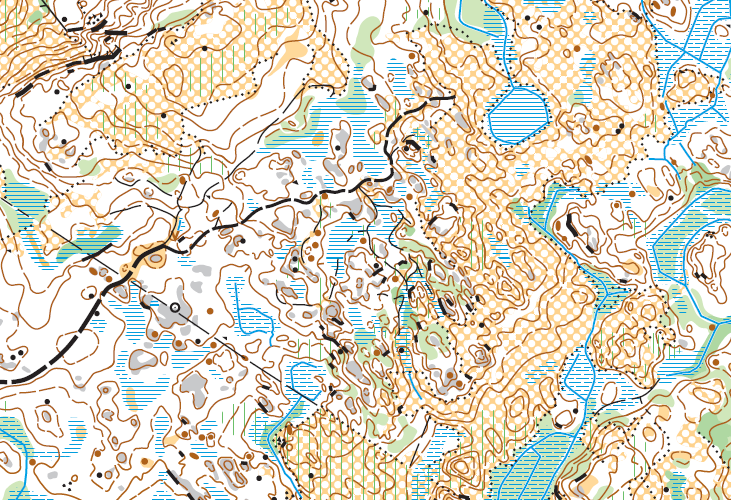
Tampere, Finland, where the 2017 Junior World Orienteering Championships were held has some pretty different maps and terrain from what I’ve seen in Canada, and there’s only so much I could learn by doing map study from afar. For example, I can tell there are bare rock hills scattered throughout the map, but what does the bare rock look like? How precisely is it mapped? Finding out the answers to these kind of questions is why the Canadian JWOC team came together for about a week prior to JWOC and trained on maps similar to those that we would later race on.

An old map of the area of the middle distance race that we studied beforehand

The big goal of the pre-JWOC training week is to get used to the different terrain. There are some challenges with this though: although my JWOC team mates and I might want to spend as much time in the terrain as possible, we still must also be tapering so that our legs aren’t too tired to run at JWOC, and some of us were also getting over jet lag.

While several European orienteering nations had already held multiple training camps in the area, being so far away from Tampere, we didn’t have that luxury. Luckily, a few of the team members were at the HPP training camp in Tampere last summer, and several others trained on their own or with groups such as the American team for a bit before the Canadian team got together.  Those who didn’t just had to learn quickly!

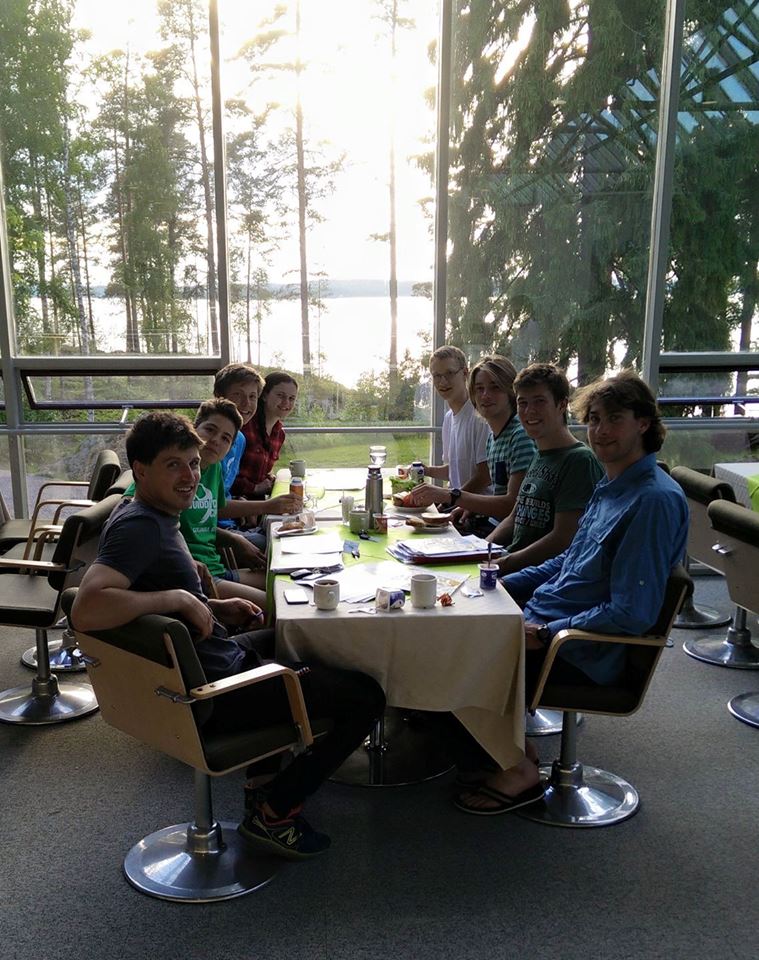
The first step of our training week was getting to Murikka, our accommodation for that week and also the JWOC week. Even though the place was under construction, we got lovely rooms with very fancy showers, connected to a common area where we would eat lunch, study maps, and watch WOC races live. That was only for the first week though- stay tuned to hear about the next week’s accommodation!

Meals at murikka.jpg
Evening snack on the first day we got to the accommodation

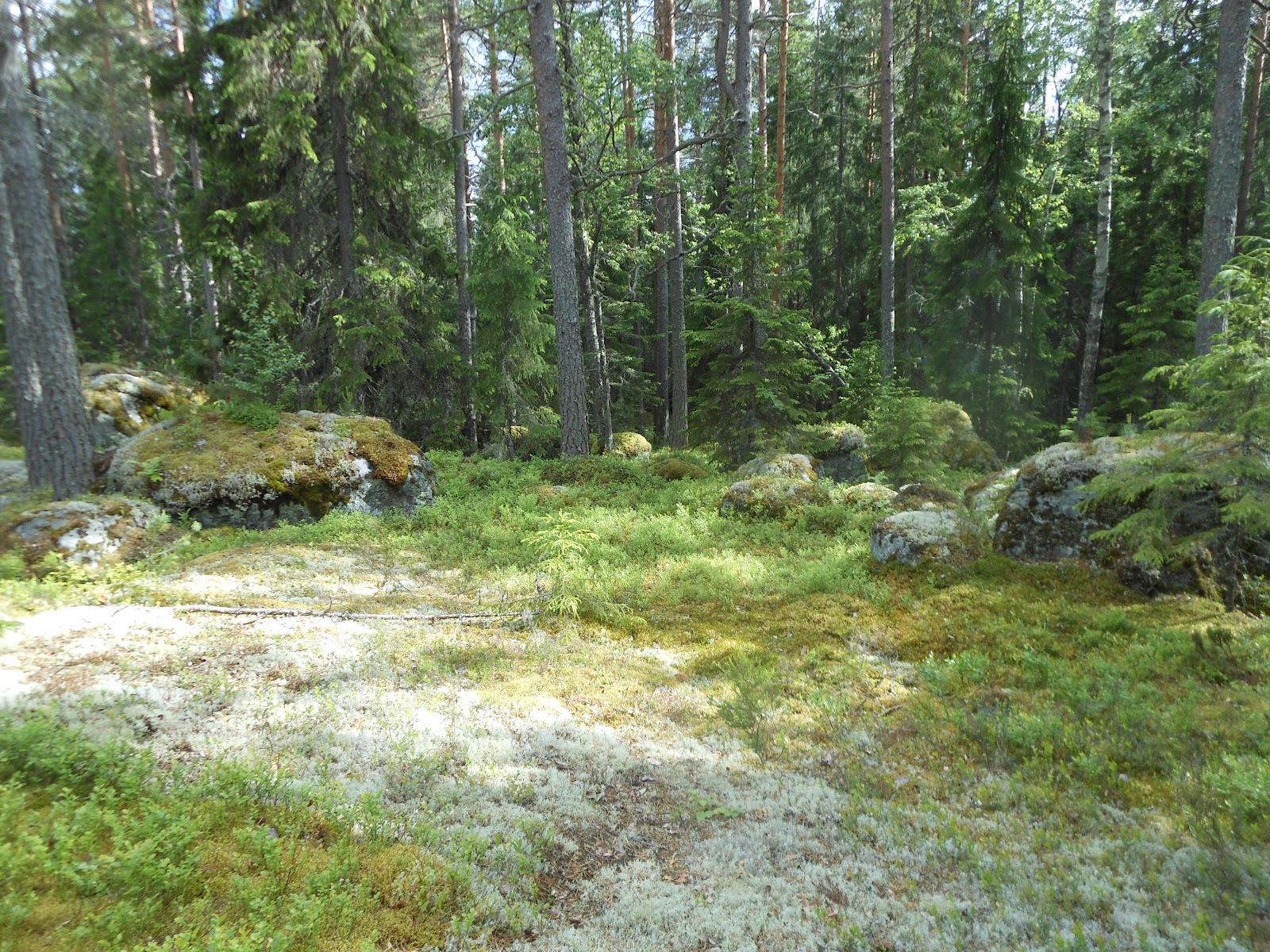
Then, on to actual training. We started with orienteering at a walking pace and figuring out what different features looked like, and then progressed up to race pace. To answer my previous questions about the bare rock: it’s not really bare. It is distinctive, but rather than slabs of rock it’s normally rock covered with a layer of light-coloured lichen.

This mossy-licheny area is mapped as bare rock. Can you find this area on the map?


As we had four different race types to prepare for (middle, sprint, long and relay), we did a variety of different trainings. One of the trainings we did was a mock race at the sprint map nearest to the area that the actual sprint would be held to practice our warm up routine, get into the racing mindset, and see some similar terrain to the sprint. In hindsight, it turns out that it wasn’t actually similar... but that’s another story.

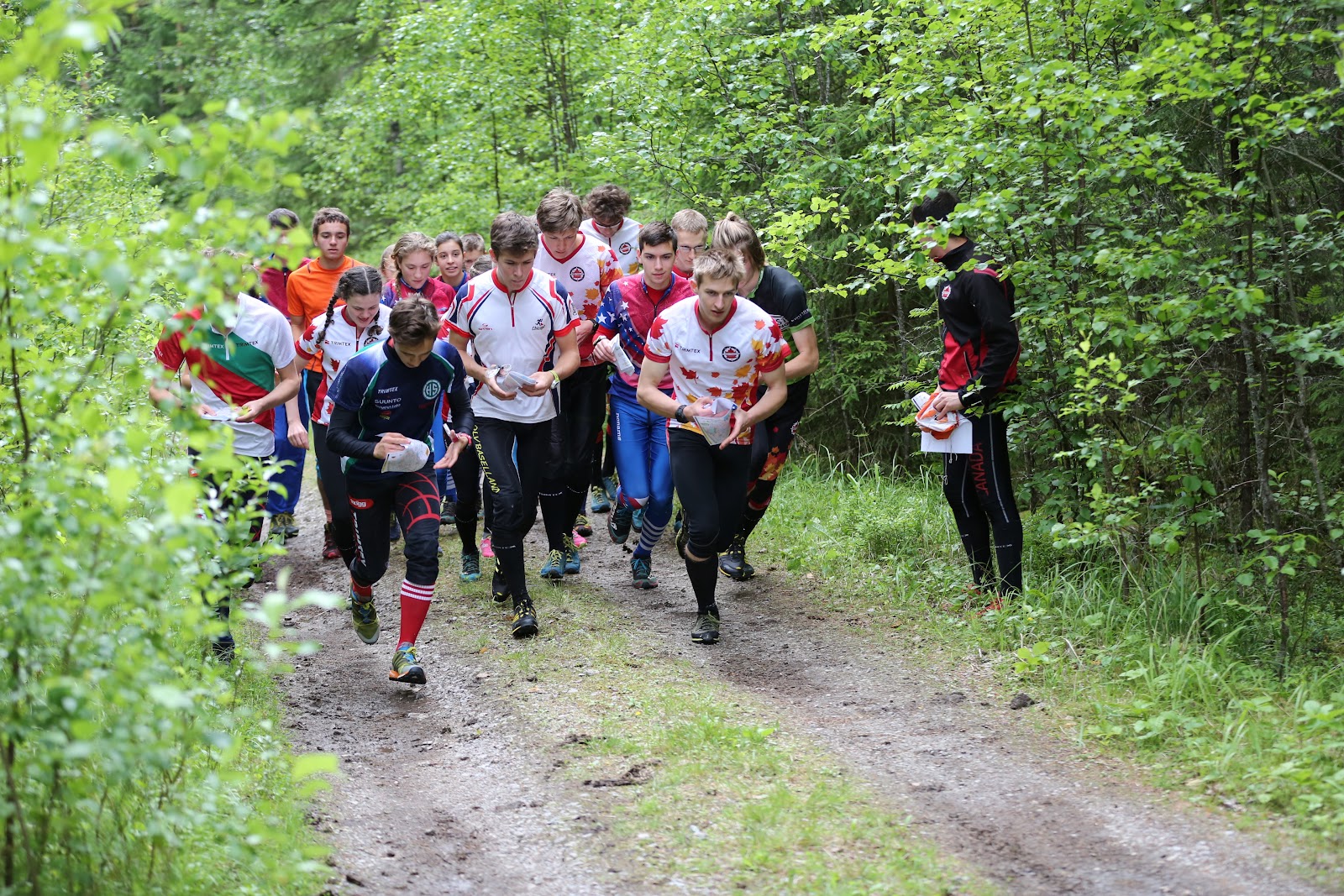
Another example of a training, one of our final ones, was a relay training with the American team. We had several short forked mass start courses that were about three controls each. We started these races against a varying number of other orienteers to simulate not only the technical/orienteering aspect of  the relay (forking and terrain), but also the mental aspect- racing head to head against different orienteers from different countries who were going to potentially the same controls, or nearby ones.

One of the mass starts:
Photo: Robert Svoboda

Besides actually orienteering, we were still pretty busy- getting interviewed by a local newspaper, practicing route choices on courses on the old maps that coach Jeff drew up, or making maps of what we thought the area for the JWOC sprint would look like now, based on google earth, satellite photos, and more.

Watching WOC with some friends from other countries counts as training if we study the route choices, right?

After the week of orienteering in Tampere terrain, we were ready (or as ready as we were going to be) for JWOC.


-Emma S.

Monday, July 10, 2017

2017 JWOC - Team Canada Results

Monday July 10th. Middle Qual  (09:00 – 12:45 local time)
Tuesday July 11th. Middle Final. A-final  (13:15 – 16:15 local time), B/C-final earlier
Wednesday July 12th. Sprint   (10:00 – 13:35 local time)
Thursday July 13th. Rest day.
Friday July 14th. Long  (09:00 – 16:15 local time)
Saturday July 15th. Relay  (13:30 – 17:15 local time)

Relay


Long Final

MEN
Jan Erik Naess - 80th
Michael Svoboda - 89th
Christian Michelsen - 114th
Leif Blake - 118th
David Bakker - 133rd
Caelan McLean - 157th

WOMEN
Emma Waddington - 51st
Emma Sherwood - 119th
Nicole Whitmore - 133rd


Sprint Final

MEN
Jan Erik Naess - 51st
David Bakker - 105th
Christian Michelsen - 114th
Leif Blake - 147th
Caelan McLean - 157th
Michael Svoboda - DQ

WOMEN
Emma Waddington - 33rd
Nicole Whitmore - 118th
Emma Sherwood - 121st

Middle Final

MEN
A Final
Michael Svoboda - 37th
B Final
Jan Erik Naess - 5th
Leif Blake - 17th
David Bakker - 27th
Christian Michelsen - DQ
C Final
Caelan McLean - 15th

WOMEN
B Final
Emma Waddington - 45th
C Final
Nicole Whitmore - 10th
Emma Sherwood - 20th

Middle Qualification ResultsTop 20 from each heat qualify for the A final
21st - 40th qualify for the B final
41+ go into the C final

MEN
Heat A
23 - Jan Erik Naess
49 - Caelan McLean
Heat B
33 - David Bakker
35 - Christian Michelsen
Heat C
20 - Michael Svoboda
34 - Leif Blake

WOMEN
Heat A
41 - Emma Sherwood
Heat B
33 - Emma Waddington
Heat C
46 - Nicole Whitmore